
.webp)


New Delhi, August 13: The Supreme Court on Thursday agreed to hear a petition challenging the use of facial recognition technology and other biometric surveillance tools by police at protest sites.
A bench headed by Chief Justice of India Surya Kant and comprising Justices Joymalya Bagchi and V Mohana tagged the plea with other petitions pending before the court in connection with the recent student protests organised by the Cockroach Janata Party (CJP).
The petition has been filed by CPI(M) Rajya Sabha MP A.A. Rahim of Kerala. It alleges that police surveillance at Delhi's Jantar Mantar involved facial mapping and vehicle-mounted surveillance technology operated with the involvement of two private entities.
Senior advocate Menaka Guruswamy, appearing for Rahim, submitted that devices were used for facial mapping and that a surveillance vehicle was deployed to collect data. The petition alleges that such data was collected without consent and hosted by private companies, in violation of provisions of the Digital Personal Data Protection Act, 2023.
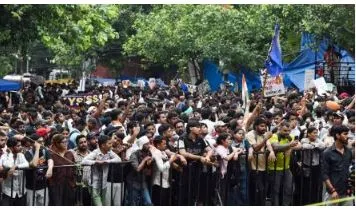
The plea stems from the Delhi Police's alleged use of digital surveillance tools to monitor protesters during demonstrations at Jantar Mantar.
According to the petition, the Delhi Police carried out biometric surveillance without any specific statutory authority. It argues that neither police standing orders governing protests nor the Criminal Procedure (Identification) Act, 2022, authorises such surveillance at civilian gatherings.
The petitioner further alleged that CCTV cameras, drones, a mobile command-and-control vehicle and other surveillance equipment were deployed to capture and process images of protesters, journalists and other people present at the protest site.
The plea contends that existing laws do not permit blanket biometric identification of individuals participating in peaceful public assemblies. It also argues that the scale and manner of the alleged surveillance violated the fundamental right to privacy guaranteed under Article 21 of the Constitution.
The respondents named in the petition include the Central government, the Delhi Police Commissioner, the National Crime Records Bureau, Aditya Infotech Ltd. and Dimension NXG Pvt. Ltd.
The petition is linked to the recent student protests at Jantar Mantar, during which protesters, journalists and others were allegedly subjected to digital and biometric surveillance. Several other petitions arising from the protests, including those concerning the police response and legal action against demonstrators, are also pending before the Supreme Court.
The bench agreed to consider the plea along with the related matters.
.webp)