
.webp)
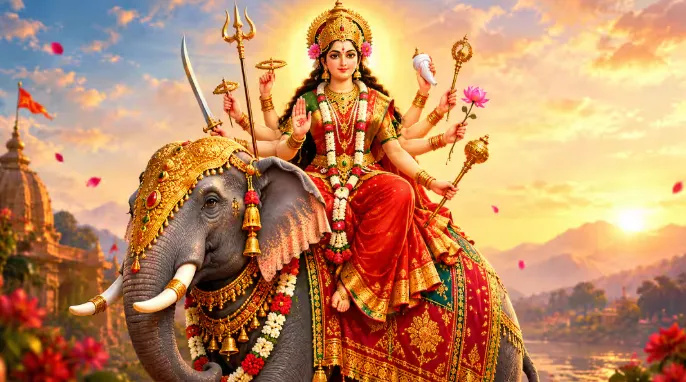
Bhubaneswar, Oct 7: The Sharadiya Navratri celebrations have begun as devotees prepare to worship Maa Durga in her Adi Shakti and Yogmaya form. This year, the arrival of the Goddess is being considered particularly auspicious by astrologers and priests, as traditional scriptures indicate that Maa Durga will descend to Earth riding an elephant.
According to traditional Hindu beliefs, the vehicle of Maa Durga's arrival and departure during Sharadiya Navratri is determined by the day of the week on which Navratri begins and ends.
For Navratri 2026, astrologers and priests are interpreting the Goddess's elephant arrival as a favourable indication. According to this traditional belief, an elephant is associated with rain, prosperity, peace and abundance.
A traditional verse associated with the Goddess's vehicles states, “Gaje cha jalada Devi…”, which is interpreted as indicating that when Maa Durga arrives on an elephant, it is considered a symbol of prosperity and good rainfall.
According to this belief, the elephant represents water and abundance. Maa Durga's arrival on an elephant is therefore traditionally associated with adequate rainfall, better agricultural conditions and prosperity.
Devotees and religious scholars believe that such an arrival symbolically indicates that the Earth may become fertile and abundant, with favourable conditions for crops and food production.
How is Maa Durga's vehicle determined?
According to Hindu religious traditions, while the lion is considered Maa Durga's permanent vehicle, she is believed to use different vehicles while arriving on Earth during the annual Durga Puja and Navratri celebrations.
The vehicle is traditionally determined based on the weekday on which Navratri begins.
If Navratri begins on a Sunday or Monday, Maa Durga is believed to arrive on an elephant, considered the most auspicious of the four traditional vehicles.
When Navratri begins on a Tuesday or Saturday, the Goddess is believed to arrive on a horse. Traditional interpretations associate this with social or political instability, conflict and natural disturbances.
If Navratri begins on a Wednesday, the Goddess's vehicle is believed to be a boat. This is regarded as a mixed sign, traditionally associated with good rainfall and fulfilment of wishes, while also carrying a belief about the possibility of excessive rain or flooding in some areas.
When Navratri begins on a Thursday or Friday, Maa Durga is believed to arrive on a palanquin. Traditional interpretations associate this vehicle with concerns over disease, epidemics and natural challenges.
Astrologer Harishankar Mishra said the Goddess's elephant arrival this year is considered a favourable combination according to these traditional beliefs.
The elephant's association with water is seen as particularly significant in a largely agrarian society, where rainfall plays a crucial role in agriculture and livelihoods.
However, these interpretations are part of religious and astrological traditions and should not be treated as scientific predictions of rainfall, crop production or natural events.
Navratri and the worship of Shakti
Sharadiya Navratri is one of the most important periods of Shakti worship in the Hindu tradition. Across nine nights and ten days, devotees worship different manifestations of Maa Durga and observe rituals with devotion.
The festival culminates in Vijayadashami, marking the triumph of good over evil.
With Maa Durga's arrival traditionally associated with an elephant this year, devotees and religious observers are looking forward to the festival with a sense of hope, prosperity and spiritual positivity.
.webp)