

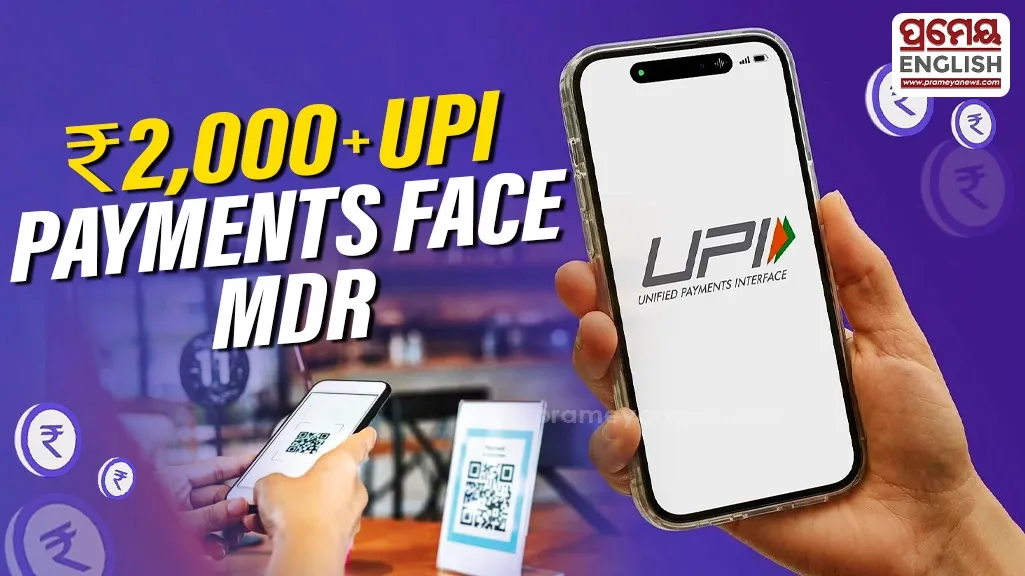
UPI payments above Rs 2,000 to merchants will attract a 0.4% Merchant Discount Rate (MDR) from October 15, with the charge being capped at Rs 300 for transactions of Rs 75,000 and above. While person-to-person (P2P) UPI transfers will remain completely free irrespective of the amount,s the new MDR on person-to-merchant (P2M) transactions means businesses will incur an additional cost on high-value payments. Though banks have been advised to ensure merchants do not pass the charge on to customers, consumers could feel its impact indirectly if traders factor the additional cost into the price of goods or services.
Thus, a Rs 3,000 payment will attract an MDR of Rs 12, while a Rs 50,000 transaction will cost the merchant Rs 200. On a Rs 1 lakh payment, the charge will be capped at Rs 300.
The move has prompted mixed reactions among merchants, particularly those handling high-value transactions.
SK Idris Ali of Humrahi Traders said the impact would depend on transaction volumes. “For small payments, there may not be much impact. But when the transaction value is high, even a small percentage becomes an additional expense for traders,” he said.
Rohan Routrai, a cement distributor, said the cumulative cost could be significant for businesses handling large payments. “When the payment amount is large, 0.4% is not insignificant. If we receive several such payments in a month, it can become a sizeable expense. But customers are used to UPI, so moving away from digital payments is not an option,” he said.
For Ankit Jena of Arisha Electronics, Jagatsinghpur, the key concern is absorbing the additional cost. “Customers increasingly prefer UPI, especially for its convenience. For high-value purchases, the MDR will become an additional business expense. We cannot ask customers to pay it separately nor is it advisable for us to incur that loss in our business too,” he said.
The government has directed banks to ensure that merchants do not pass the MDR on to customers. P2P transactions will remain free irrespective of the amount, while P2M transactions up to Rs 2,000 will remain outside the MDR framework.
Certain sectors, including railways, telecom, insurance and fuel, will attract a flat Rs 5 MDR on UPI payments above Rs 2,000.
For consumers, the change means they can continue scanning QR codes and making UPI payments without a separate transaction fee.
Subhashree Ray, a consumer, said keeping UPI free for users was important. “UPI has become part of everyday life because it is simple and convenient. As long as customers are not charged extra, the new rule should not affect regular transactions. Merchants should not add the MDR separately to the bill,” she said.
NPCI has said the revised framework will help support investments in payment infrastructure, cybersecurity and innovation. The MDR is not a government tax but a charge within the digital payments ecosystem.
For consumers, the takeaway is simple: UPI remains free at the point of payment. The new cost will primarily be borne by eligible merchants accepting payments above Rs 2,000.
(Afreen Firdaus)