

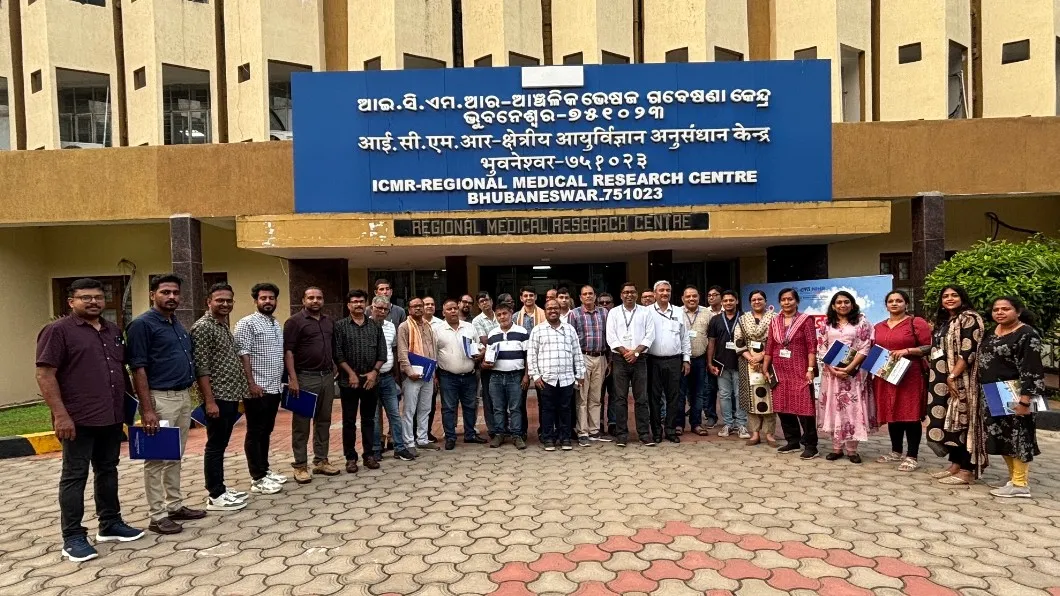
Bhubaneswar, September 15: Journalists from Keralam and Rajasthan on Tuesday visited the ICMR-National Institute of Health Research (NIHR), Bhubaneswar and learnt about the institute’s research programmes, scientific achievements and contributions to public health. Scientists and officials of the institute shared information on its research initiatives and science outreach activities.
ICMR-NIHR, Bhubaneswar Director Dr. Sanghamitra Pati, highlighted the commendable work and research initiatives undertaken by ICMR-RMRC, Bhubaneswar during the COVID-19 pandemic. She also underlined the important role of the media as a bridge between health research and the public, stressing the need to communicate scientific findings and public health information in a simple, accurate and credible manner.
The visiting teams were briefed on the Tribal Health Observatory, under which ICMR-NIHR serves as the nodal centre for a Ministry of Tribal Affairs project covering 65 districts and more than six lakh Particularly Vulnerable Tribal Groups. The Odisha Tribal Family Health Survey has also covered around 40,000 people across 14 districts.
They were also briefed on AdFalciVac, an indigenous recombinant multi-stage malaria vaccine candidate developed jointly by ICMR-NIHR, ICMR-National Institute of Malaria Research and the National Institute of Immunology. The vaccine targets two key stages of Plasmodium falciparum and has shown promising results in pre-clinical studies.
The teams were further informed about the institute’s Tuberculosis research and laboratory services, with ICMR-NIHR being one of the six National Reference Laboratories for Tuberculosis and supporting laboratory services across 10 States, besides conducting research on the burden of tuberculosis among tribal populations.
The Regional Viral Research and Diagnostic Laboratory, upgraded to the regional level in 2018, was highlighted for its role in the diagnosis of diseases including Japanese Encephalitis, dengue, chikungunya and H1N1, while its measles and rubella surveillance work has received recognition from the World Health Organization.
Information was also shared on the HIV-1 Viral Load Laboratory, which supports 14 ART centres in Odisha and became the first laboratory in India outside the National AIDS Control Programme to receive NABL accreditation.
The teams were briefed on the institute’s One Health initiatives in Koraput, including anthrax control, awareness on animal vaccination and coordination among the health, animal husbandry, forest and agriculture departments. The Model Rural Health Research Units at Tigiria, Sergada and Dumka were also highlighted for their work on rural and tribal health, disease surveillance and new diagnostic technologies.
The teams later visited the Regional Viral Research and Diagnostic Laboratory, National Reference Laboratory for Tuberculosis, Biomolecular Engineering Laboratory, and Microbiology and One Health Laboratory, gaining first-hand exposure to the institute’s research infrastructure, laboratory activities and ongoing research. A video on the institute’s science outreach activities was also screened, followed by presentations by scientists.