
.webp)


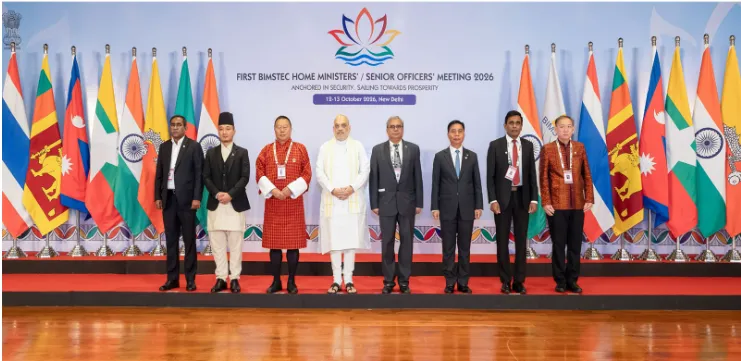
New Delhi, Oct 13: India and other BIMSTEC member countries on Tuesday approved five key initiatives to strengthen regional security and cooperation, covering human trafficking, drug control, money laundering, terror financing and disaster management.
The decisions were taken at the first BIMSTEC Home Ministers' Meeting, chaired by Union Home Minister Amit Shah in New Delhi. The meeting also adopted the Delhi Declaration, which reaffirmed the commitment of member countries to improving security, trust and cooperation in the Bay of Bengal region.
The five initiatives include a convention to prevent human trafficking, a plan to control drug trafficking, a memorandum of understanding (MoU) to strengthen efforts against money laundering and terror financing, a plan to identify and prevent illegal financial flows, and a plan to improve coordination during natural disasters.
The convention against human trafficking aims to improve cooperation among member countries to prevent trafficking, punish offenders and protect and rehabilitate victims.
The drug control plan focuses on stopping the illegal trade of narcotic drugs, psychotropic substances and chemicals used to make drugs.
Also read:Odisha Cabinet approves Rs 2,450 crore Dakshyata Vikas Yojana to skill 4.2 lakh youth
The MoU on money laundering and terror financing provides for expert training, sharing of information and best practices, financial investigations and recovery of assets linked to crime. It also covers measures to prevent money laundering, terror financing and the funding of activities linked to the spread of weapons of mass destruction.
The plan to prevent illicit financial flows aims to identify the sources, risks and channels through which illegal money moves across member countries.
Another plan seeks to improve preparedness and coordination during natural disasters in the Bay of Bengal region. It includes joint exercises, early warning systems, disaster mapping, training, information sharing, research and the use of technology to reduce disaster risks, including those from tsunamis.
The Delhi Declaration called for stronger cooperation against cross-border terrorism, terror financing, radicalisation, drug and human trafficking, cybercrime and organised crime. It also stressed the need for timely information sharing, legal assistance, extradition and better implementation of existing agreements.
The declaration also highlighted the need to protect victims of human trafficking who are forced into online scams and appreciated India's role in strengthening regional security cooperation.
According to a statement from the Ministry of Home Affairs (MHA), India reaffirmed its commitment to sharing expertise in police training, counter-terrorism operations and forensic investigations. The meeting also discussed cooperation in disaster management, including the proposed BIMSTEC Centre for Disaster Management in Jamnagar, Gujarat.
Addressing the meeting, Shah stressed India's policy of 'Zero Tolerance' towards terrorism and called for stronger cooperation against terrorism, organised crime, drug trafficking, human trafficking and emerging cyber threats.
He said timely intelligence sharing, financial investigations, legal assistance and extradition were essential to ensure that criminals and terrorists were brought to justice.
Shah said member countries must work together to ensure that terrorist groups do not find safe havens, recruit members, provide training, raise funds or operate against neighbouring countries from any part of the region.
He added that cooperation in legal assistance and extradition, in line with national laws and applicable treaties, could help bring criminals to justice.
The Home Minister identified five key areas for cooperation: drug control; counter-terrorism and legal cooperation; the return of fugitive criminals; cybersecurity and cybercrime investigations; and institutional cooperation and capacity building.
He also called for a coordinated regional effort to stop illegal financial transactions and terror financing, stressing the need for closer cooperation among law enforcement, intelligence and border management agencies.
Referring to drug trafficking, Shah said it was essentially 'death trafficking' and that there was nothing 'golden' about the illegal narcotics trade.
He said drug trafficking threatened the lives of young people, society, culture and future generations, adding that no single country could tackle the problem alone. BIMSTEC, or the Bay of Bengal Initiative for Multi-Sectoral Technical and Economic Cooperation, comprises Bangladesh, Bhutan, India, Myanmar, Nepal, Sri Lanka and Thailand. The grouping connects South and Southeast Asia and promotes cooperation across several sectors.
The decision to hold meetings of BIMSTEC Home Ministers was taken at the fourth BIMSTEC Summit in 2018 to strengthen regional security cooperation. At the sixth BIMSTEC Summit, Prime Minister Narendra Modi reiterated India's support for the initiative and its commitment to hosting the first meeting. (ANI)
.webp)