


By Afreen Firdaus
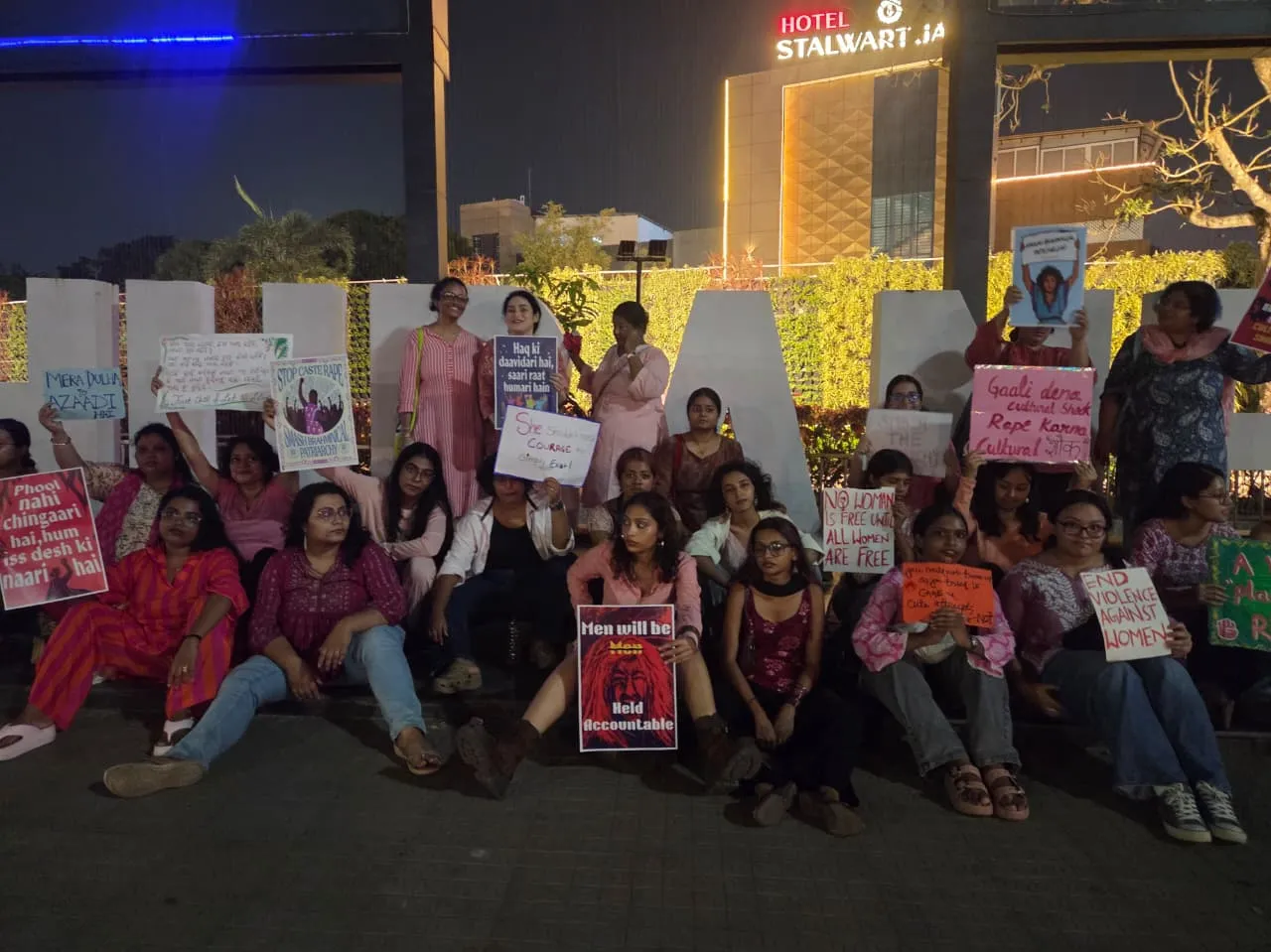
Bhubaneswar, Oct 3: Women took to the streets of Bhubaneswar on Gandhi Jayanti as part of a nationwide ‘Patriarchy Go Back / Pittrasakta Bharat Chodo’ walk, calling for safer public spaces, better civic infrastructure and the freedom to move without fear or restrictions.
The walk, organised in solidarity with survivors of sexual assault, began at Biju Patnaik Park at 8.30 pm and concluded at Master Canteen Square. Organisers said Bhubaneswar was chosen as one of the venues because of its significance as the capital of Odisha, with the route passing through Dharana Sthala, a recognised site of public protest in the city.
The action was linked to the WhyLoiter campaign, which has been organising walks since 2015 to encourage women to occupy public spaces without having to justify their presence. Participants said the initiative was not intended as a conventional protest or rally, but as a peaceful collective assertion of women’s right to be visible and present in the city.
The organisers raised three key demands — solidarity with survivors of sexual violence, better basic infrastructure such as streetlights, footpaths and public toilets, and the right of women to occupy public spaces without being asked to stay indoors.
The campaign gained renewed relevance following recent cases of sexual violence, with participants saying women should not have to bear additional restrictions on their movement because of concerns over their safety.
“I wanted to be part of this because public spaces belong to women too. There are too many cases of sexual assault and eve-teasing. Women should be able to occupy public spaces without fear. This walk is about standing in solidarity with women,” said Prakruti Singh, a law student.
The walk also highlighted everyday infrastructure concerns that can determine how safely women navigate public spaces.
“For me, safety is not only about policing. A well-lit street, a usable footpath and accessible public toilets make a huge difference. These are basic facilities, but they affect how freely women can move around the city,” said Pratiksha, an education consultant from Odisha.
The Bhubaneswar action was initiated with the involvement of local participants who reached out to the WhyLoiter campaign to organise the peaceful walk in the city.
“I reached out to the WhyLoiter campaign to initiate the idea of a peaceful walk here. They responded and added me to their group, where I met Rakhshitha, and together we organised this walk in Bhubaneswar, Odisha,” said Soma Marndi, a Class XII student of Ravenshaw Higher Secondary School and coordinator of the Odisha group of WhyLoiter campaign.
“It is a walk in solidarity with survivors of sexual assault and rape, with women coming together to reclaim the night,” she added.
For some participants, the walk was also about challenging the normalisation of restrictions imposed on women in the name of safety.
“I was part of the walk because I believe women should occupy public spaces too. We see too many cases of sexual assault and eve-teasing, and women are often expected to change their behaviour because of these incidents. We need solidarity and safer spaces for women,” said Sonali Priyadarsini, founder of ExtraOdinari.
The Bhubaneswar walk followed a ‘Walk for Women’ action held the previous week and was part of similar activities organised in cities across India, including Mumbai, Delhi, Chennai, Kolkata, Tezpur, Nainital and Dehradun.
The WhyLoiter campaign draws inspiration from the bookWhy Loiter? Women and Risk on Mumbai Streets, authored by Shilpa Phadke, Sameera Khan and Shilpa Ranade. The campaign has argued that greater participation of women in public spaces can help normalise their presence and challenge the idea that women should restrict their movement for their own safety.
With women walking together through the city at night, the Bhubaneswar action ended with a simple assertion- that safety should not come at the cost of women’s freedom to occupy and move through public spaces.