
.webp)

New Delhi, September 12: Prime Minister Narendra Modi on Saturday shared warm and cordial moments with Russian President Vladimir Putin and Chinese President Xi Jinping as the 18th BRICS Summit got underway at Bharat Mandapam in New Delhi under India's chairship.
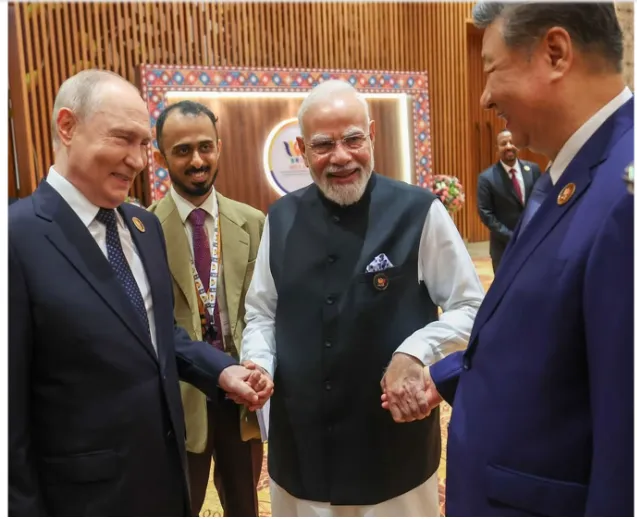
Photographs shared on social media showed Modi greeting Putin and Xi together, holding their hands and exchanging smiles. The visuals underscored the bonhomie among the three leaders as the expanded BRICS grouping entered its third decade.
 In another photograph, Modi was seen walking alongside Putin, Xi and Iranian President Masoud Pezeshkian. He also shared a picture of himself interacting with Indonesian President Prabowo Subianto, with Putin standing nearby. Another image showed Modi and Putin walking together and sharing a light moment.
India is hosting the two-day BRICS Summit on September 12 and 13 after assuming the group's chairship for 2026. Earlier in the day, Modi welcomed the participating BRICS leaders at Bharat Mandapam, the summit venue. The leaders were welcomed against a backdrop featuring the iconic Ramanathaswamy Temple in Rameswaram, Tamil Nadu.
Ahead of the summit, Modi held separate bilateral meetings with Putin and Pezeshkian on Friday, met United Nations Secretary-General António Guterres and addressed the BRICS Business Forum.
The meeting with Putin was the second between the two leaders this year. According to the Ministry of External Affairs, they had earlier met on the sidelines of the 26th SCO Summit in Bishkek in August.
During Friday's meeting, Modi and Putin reviewed progress in bilateral cooperation across political, economic, defence, energy, space, skill mobility and people-to-people ties. They also discussed India's BRICS chairship, India-Russia cooperation in multilateral forums and key regional and global developments, including conflicts in West Asia and the Black Sea region.
Modi also highlighted the expanding economic partnership between India and Russia following their participation in the INNOPROM industrial exhibition at Bharat Mandapam.
"The India-Russia economic partnership continues to gather momentum. In Delhi, President Putin and I participated in INNOPROM, bringing together several companies from both countries. It reflects the growing depth of our business engagement," Modi said in a post on X.
Following their bilateral talks, Modi and Putin travelled together by car to Bharat Mandapam before visiting the exhibition. The two leaders also discussed an ambitious target of increasing bilateral trade to USD 100 billion by 2030.
As part of cultural diplomacy, Modi presented Putin with a Russian translation of theThirukkural, the classical Tamil work associated with saint-poet Thiruvalluvar.
"Two thousand years ago, Thiruvalluvar wrote the Thirukkural. It includes the entire gamut of human life. It has been translated into the Russian language. I am confident that the people-to-people contact will increase with the translation of the Thirukkural into Russian, which will play a big role in strengthening our relations," Modi told Putin.
In a separate social media post, Modi said he had gifted Putin the Russian translation of theThirukkural, describing it as a work carrying Thiruvalluvar's "eternal wisdom" across languages and borders.
Putin arrived in New Delhi on Friday ahead of the BRICS Summit and was received by Union Minister of State for External Affairs Kirti Vardhan Singh.
Modi also met Iranian President Masoud Pezeshkian on Friday, continuing discussions from their earlier meeting on the sidelines of the SCO Summit in Bishkek.
According to the MEA, the two leaders reviewed various aspects of bilateral relations. Modi thanked Iran for its continued high-level participation in BRICS-related meetings despite challenging circumstances.
The Prime Minister also thanked Pezeshkian for participating in the Leaders' Session of the BRICS Business Forum and highlighted the grouping's potential to enhance resilience, innovation, cooperation and sustainability among countries of the Global South.
The two leaders also exchanged views on the ongoing conflict in West Asia. Modi reiterated India's consistent position that disputes should be resolved through dialogue and diplomacy and stressed the need for sustained efforts to achieve lasting peace and stability in the region.
He also emphasised the importance of ensuring freedom of navigation and commerce, along with the safety and well-being of seafarers.
.webp)