
.webp)


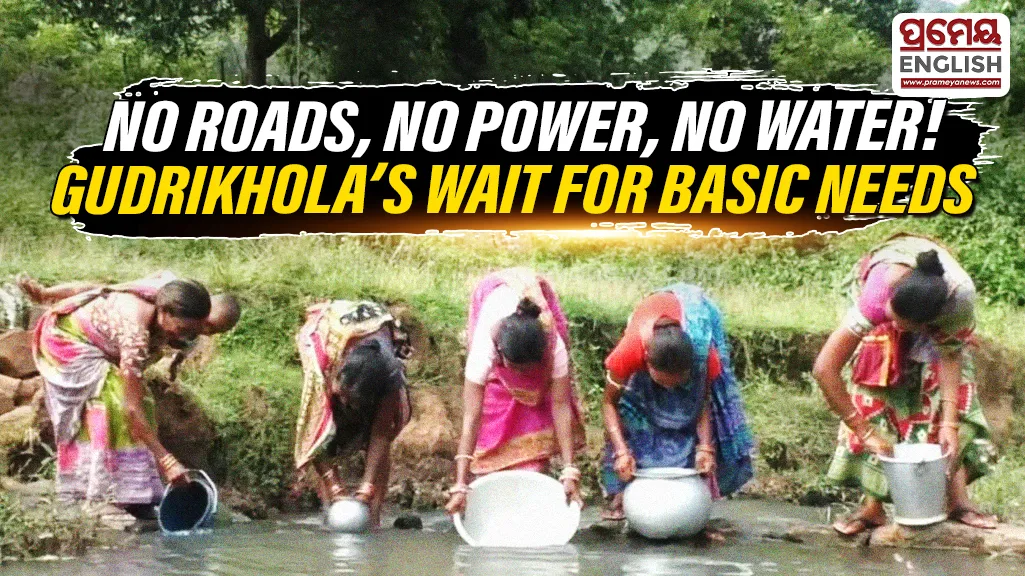
Kandhamal, Oct 14: While Odisha continues to pursue digital connectivity and rural development, residents of Gudrikhola village in Kandhamal district are still struggling to access basic amenities, including an all-weather road, electricity and safe drinking water.
Located in Dindira Gram Panchayat under Phiringia block, the village is barely 25 kilometres from the district headquarters, Phulbani. Yet, according to residents, the benefits of development have still not reached the village in a meaningful way.
Surrounded by hills and forests, Gudrikhola is home to more than a hundred families who continue to face difficulties in accessing healthcare, education and other essential services.
For residents of Gudrikhola, travelling to nearby areas remains a daily challenge. The village lacks a proper motorable road, forcing people to depend on uneven, rocky and winding pathways.
Also Read:
The difficult terrain makes transportation challenging, particularly during the rainy season. Residents say the absence of proper road connectivity affects their daily lives and limits access to essential services.
Sasmita Kanhara, a resident, highlighted the difficulties people face while travelling along the village's rough and uneven paths.
The electricity situation is another major concern. According to villagers, the settlement lacks proper electricity infrastructure, including regular power connections.
Solar lights provided to some households have reportedly stopped working, leaving residents in darkness after sunset. Many families continue to rely on traditional oil lamps to get through the night.
The lack of reliable lighting also affects children's studies and makes routine household activities difficult after dark.
Villagers have questioned why reliable electricity remains unavailable despite years of rural development initiatives.
Access to safe drinking water is a major challenge in Gudrikhola. The village reportedly has only one well serving more than a hundred families.
During summer, when the well dries up, residents are forced to depend on water from a nearby stream.
The situation has raised concerns about drinking water safety and the risk of waterborne diseases. Despite various government programmes aimed at improving rural water supply, residents say they continue to struggle to secure sufficient clean drinking water.
Jochhana Rani Mallik, a villager, described the difficulties faced by residents in meeting their daily water needs.
The lack of road connectivity also creates serious challenges during medical emergencies.
According to villagers, ambulances cannot reach Gudrikhola because of the difficult approach. When someone falls seriously ill, residents have to carry the patient on a cot or makeshift stretcher over a long distance to reach the nearest motorable road.
Patients are then transported to healthcare facilities in Phiringia or Phulbani.
The situation can make access to timely medical treatment particularly difficult for elderly people, pregnant women and seriously ill patients.
Educational facilities are another concern for families in the village. Gudrikhola reportedly has neither a school nor an Anganwadi centre.
The nearest Anganwadi centre is located in Sarukui village, around seven kilometres away. Parents face difficulties taking their children there, while some school-going children reportedly walk between 12 and 15 kilometres daily.
The long journeys and challenging terrain create additional barriers for children seeking education.
With limited access to schooling, healthcare, drinking water, electricity and roads, residents say their village continues to face multiple basic infrastructure challenges.
Villagers Say Repeated Complaints Have Yielded Little
Residents said they had approached local representatives and officials, including the village sarpanch, Block Development Officer (BDO) and District Collector, seeking solutions to their problems.
However, they alleged that they had yet to see substantial improvements on the ground.
Their concerns were brought to the attention of Kandhamal Chief Development Officer and Executive Officer of the Zilla Parishad, Shambhunath Nandi.
After being informed about the situation, Nandi reportedly contacted the BDO, the Rural Water Supply and Sanitation (RWSS) authorities and TP Southern Odisha Distribution Limited (TPSODL).
He assured that steps would be taken to address the village's problems as soon as possible.
Gudrikhola's situation has raised questions about the delivery of basic services in remote rural settlements.
Residents are waiting for a proper road, reliable electricity, safe drinking water and improved access to education and healthcare.
While the administration has assured action, villagers are hopeful that these commitments will translate into tangible improvements in their everyday lives.
For the people of Gudrikhola, development is not about grand promises or modern technology. It begins with a road that an ambulance can travel on, electricity that lights their homes, clean water to drink and schools that children can reach safely.
The question remains is when will Gudrikhola finally receive the basic facilities its residents have been waiting for?
.webp)