


Rourkela, May 26: Researchers from the Department of Biotechnology and Medical Engineering at National Institute of Technology Rourkela (NIT Rourkela) have developed an AI-enabled auto focusing technology that can improve microscopic imaging for biomedical diagnostic applications. The technology is capable of producing rapid, accurate, and repeatable results with minimal human intervention.
Developed in collaboration with Glowvista Instruments Private Limited, a startup incubated at NIT Rourkela’s Incubator center (FTBI), the research team has secured a patent titled, “A Method for Autofocusing in Optofluidic Microsystems and Processes” for the technology (Patent number: 589270; Application number: 202431080016).
In healthcare industry, microscopy technology is used by doctors and researchers to diagnose cells, tissues, microorganisms, and biological structures that cannot be seen with the naked eye. Detection of diseases such as cancer, pathology-related conditions, and identification of infections, like malaria and tuberculosis, are done using this technology. On the research front, it is used for drug development and point-of-care diagnosis by providing detailed visual information.
While conventional microscopy systems rely on manual adjustments, they are time-consuming and prone to human errors, which can lead to inconsistent results, inaccurate diagnoses, and delays in treatment. Such limitations can become fatal when dealing with complex biological samples or in cases of emergency diagnostic requirements.
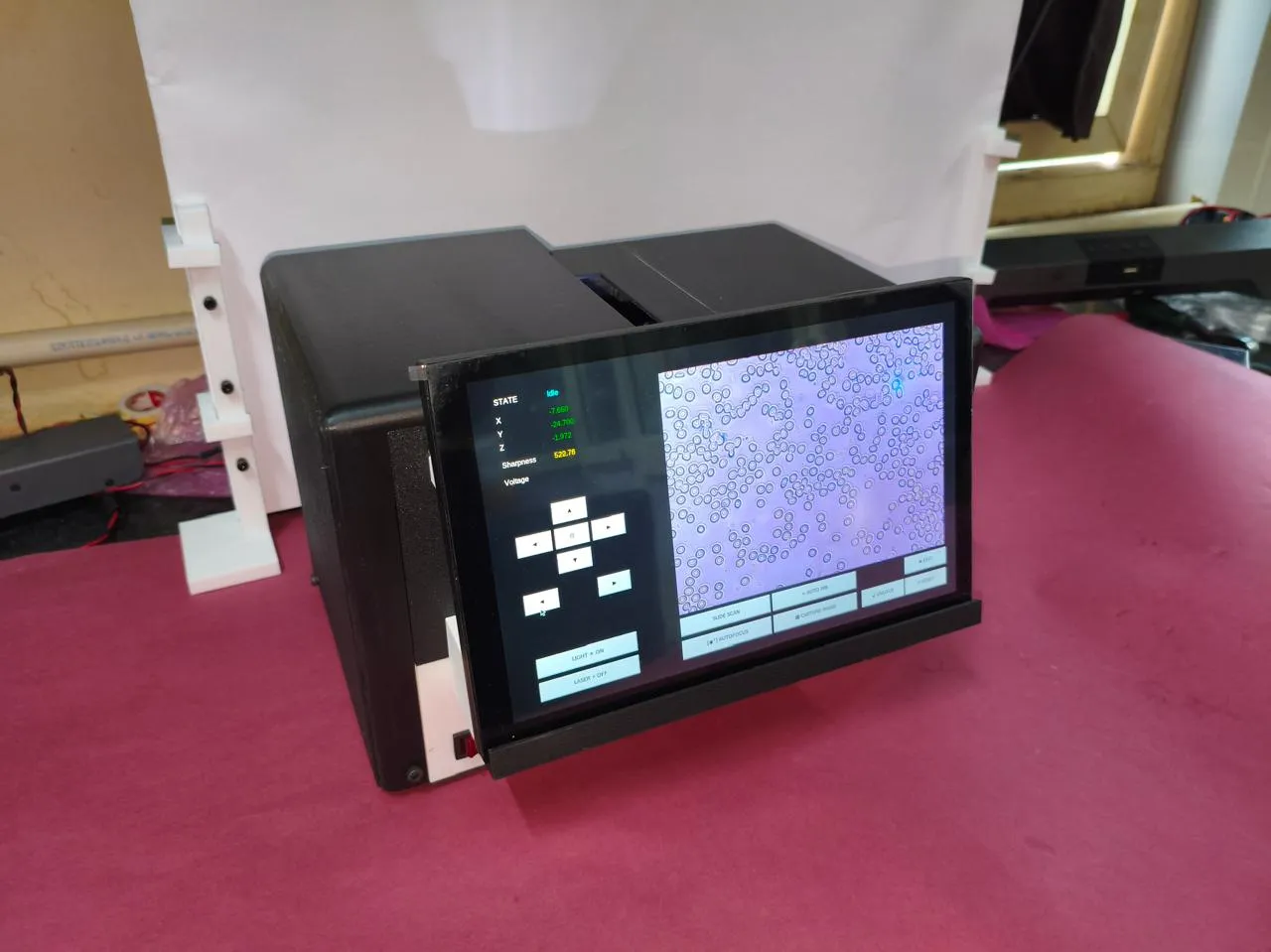
To address these challenges, the NIT Rourkela research team has developed an optofluidic digital microscopy platform that uses deep learning technology integrated with an optical imaging system and automated motion control, which allows it to continuously analyse microscopic images in real time and automatically adjust focus through an intelligent feedback mechanism.
The research team includes Prof. Earu Banoth, Assistant Professor, Department of Biotechnology and Medical Engineering, NIT Rourkela, and Founder & Director (Non-Executive) of Glowvista Instruments Pvt. Ltd.; Dr. Shaik Ahmadsaidulu, Research Graduate, NIT Rourkela; along with NIT Rourkela incubatee, Mr. Amol Lalchand Salve, Design Engineer, and Padmanaban Selvakumar, Product Manager, from Glowvista Instruments Pvt. Ltd.
Developed at a cost of Rs. 1.20 Lakh, in lab-scale testing, the system showed accurate results in detecting Acute Lymphoblastic Leukemia (Blood Cancer), malaria, and Complete Blood Cellscounts through blood cell classification (5-class and 7-class categorization).
Speaking about the developed technology, Dr. EaruBanoth, said,“Our target is to develop a simple handheld system that should work as effectively as imported automated microscopy technology with precise information. Further, the system should be extended for various applications, unlike Flow Cytometers and Imaging Flow Cytometers.”
Key features of the developed system include:
●AI-powered intelligent autofocus with real-time image processing.
●Automated motion control for precise focus adjustment.
●Enhanced imaging of complex biological and micro-scale samples.
●Cloud-enabled learning for continuous performance improvement.
●User-friendly operation with improved accuracy, repeatability, and efficiency.
The system has been developed with research grants from the Anusandhan National Research Foundation (ANRF), Department of Science and Technology (DST), and Department of Biotechnology (DBT), Government of India.
The developed technology has potential applications in -
●Biomedical diagnostics and disease detection
●Digital pathology and tissue imaging
●AI-assisted microscopy and automated imaging
●Point-of-care healthcare devices
●Microfluidic analysis and biofluid monitoring
●Biomedical and Life sciences research
●Smart laboratory automation
●Portable and remote diagnostic systems
Speaking about the next steps of this research, Prof. Banoth said, “We are extending our work to develop complete ground truth data as well as scale up the work for deployment at various locations for field testing and to obtain feedback from diagnostic centres and research laboratories. The data will be used for further approvals towards developing a market-ready product, and we look forward to its market launch. At present, we are looking for funding support from both the research and startup sides to scale up the work.”
Aligning with the Government of India’s Make in India initiative, the developed innovation reflects NIT Rourkela’s commitment to advancing indigenous research-driven innovations supporting accessible, next-generation healthcare solutions for society.