

.webp)


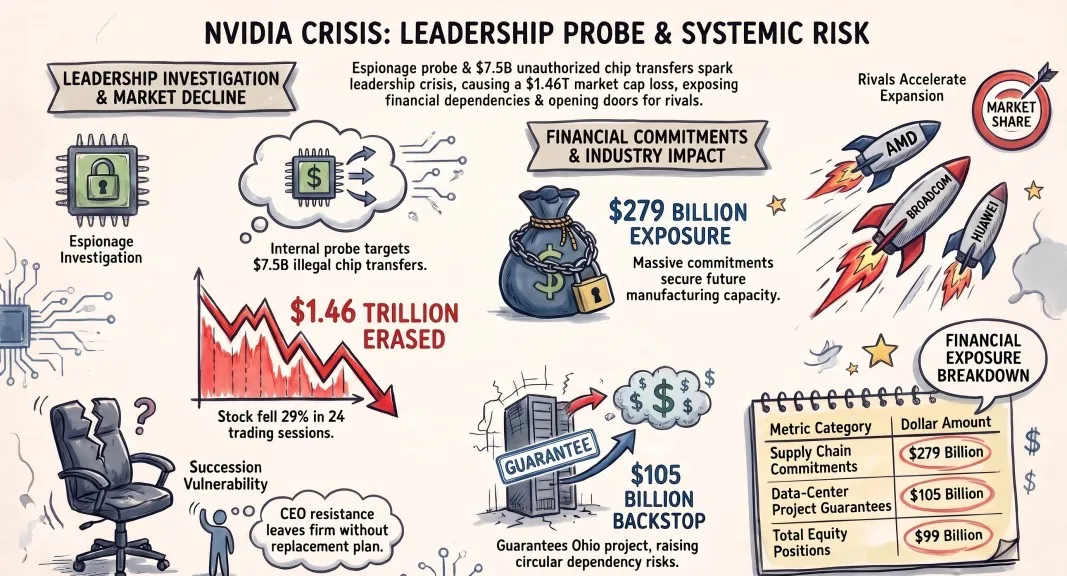
Espionage allegations against Jensen Huang threaten global AI stability.
US authorities are examining Nvidia chief executive Jensen Huang over an alleged illicit connection with Alice Huang, a businesswoman reportedly tied to Chinese intelligence. Independent directors have hired former acting US attorney Joon H. Kim to lead an internal probe into whether foreign operatives deliberately targeted the chipmaker's leadership. Investigators suspect that Megaspeed International, a Singapore-based cloud firm partnered with Nvidia, facilitated the transfer of restricted H100, H200, and A100 processors to Chinese entities. Reports indicate that this network successfully secured advanced hardware worth roughly $7.5 billion after standard export channels stalled.
Market reaction and succession concerns
Investors reacted sharply to the espionage claims, wiping $1.46 trillion off Nvidia's market capitalization over 24 trading sessions. Share prices tumbled 29 percent, falling from $239 on October 6 to $169 by November 10. While Huang owns 3.5 percent of the tech giant, he lacks special voting rights, meaning shareholders could force his removal if they determine his actions endangered corporate security or violated trade laws. Finding a replacement poses severe challenges. Executives like Chief Financial Officer Colette Kress, accelerated computing head Ian Buck, or Arm chief executive Rene Haas possess distinct technical or financial strengths but lack Huang's established political influence in Washington. Huang has historically operated with a flat organizational structure and resisted formal succession planning, making a sudden transition highly disruptive.
Risk to global computing infrastructure
Beyond executive continuity, the controversy highlights deep vulnerabilities across the broader technology sector. Nvidia currently holds $99 billion in equity positions and maintains $279 billion in supply commitments to secure memory and manufacturing capacity for future GPU generations. Furthermore, the firm has guaranteed up to $105 billion for an Ohio data-center project linked to OpenAI, alongside $29 billion in various cloud-service agreements. Critics warn these heavy infrastructure financing arrangements create precarious circular dependencies. If regulatory crackdowns or internal crises stall GPU production, cloud providers and startups relying entirely on this hardware pipeline to monetize their own platforms could face immediate operational bottlenecks and funding shortfalls.
Also read: Retail inflation climbs to two-year high of 6.09% in October, breaches RBI’s upper limit
Competitors gain ground
Rivals are already moving to capture market share as computing demands evolve. Chinese hardware manufacturers like Huawei are aggressively filling the void left by US export controls. Software developers are also optimizing their algorithms to require fewer resources, demonstrated by efficient models like DeepSeek R1. Simultaneously, hardware alternatives from AMD and Broadcom are attracting serious interest from enterprise customers seeking to diversify their supply chains. Nvidia maintains a dominant software ecosystem through CUDA, but prolonged leadership instability could accelerate the industry's transition toward alternative computing architectures. If the primary supplier of global AI infrastructure falters, the entire ecosystem of startups and data centers heavily tethered to its processors might be forced to radically alter their expansion strategies.
.webp)