
.webp)
Catastrophic Glacier Collapse
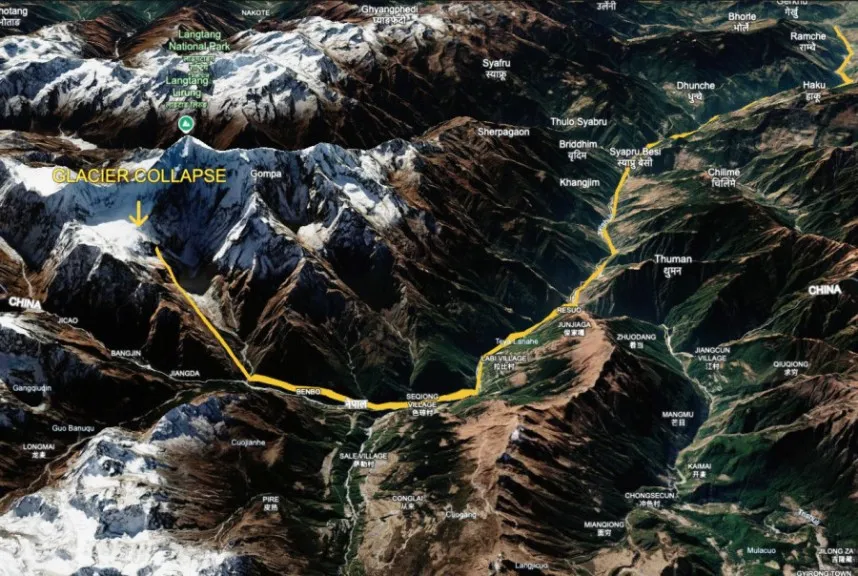
Colossal failure of high-altitude bedrock and a subsequent glacier collapse triggered the devastating flash flood across Rasuwa. The sudden fracture sent a 100-meter-high wall of water crashing through vulnerable mountain communities. Scientific investigations confirmed that a 600-meter-wide section of ice and rock abruptly detached from an altitude of 5,200 meters. This immense block then plunged 1,200 meters directly into the river valley below.
Experts at the International Centre for Integrated Mountain Development calculated the collapsed debris volume reached nearly 200 million cubic meters. This equals the water volume of roughly 80,000 Olympic swimming pools. Intense friction rapidly melted the falling ice, merging it with loose soil and jagged rocks to form a violent debris flow. This sudden accumulation completely blocked the trans-boundary river, establishing an unstable natural dam. Fast-accumulating waters eventually shattered this temporary barrier, unleashing extreme downstream devastation along the Bhotekoshi river corridor.
Climate Impact on Mountain Slopes
Himalayan mountain ranges face increasingly destabilised geological conditions due to persistent regional warming. Glaciers across the region continue losing immense ice reserves at rapid rates over the past three decades, fundamentally altering structural stability across the entire mountain system. Researchers initially misidentified the disaster trigger as a standard 4.4 magnitude earthquake. Glaciologists later clarified that the sheer force of the falling debris alone generated a powerful 5.2 magnitude seismic signal. Dr. Upmanu Lall noted that prolonged elevated temperatures likely saturated the high-altitude slopes. This steady water seepage weakened the fundamental bedrock over several months before the final fracture.
Shortcomings in Early Warning Systems
Local security officials attempted to broadcast mobile text alerts when the threat emerged. However, the extreme velocity of the icy debris flow left communities with virtually zero reaction time. Survivors recalled having only fleeting moments to seek higher ground before the raging torrent obliterated local markets. Deploying advanced soil moisture sensors and real-time infrared monitoring remains essential to properly defend remote settlements against these sudden mountain hazards.

Aftermath Rasuwa Nuwakot Trisuli Flood
Source: the Kathmandu Post, Google Earth Map
.webp)