



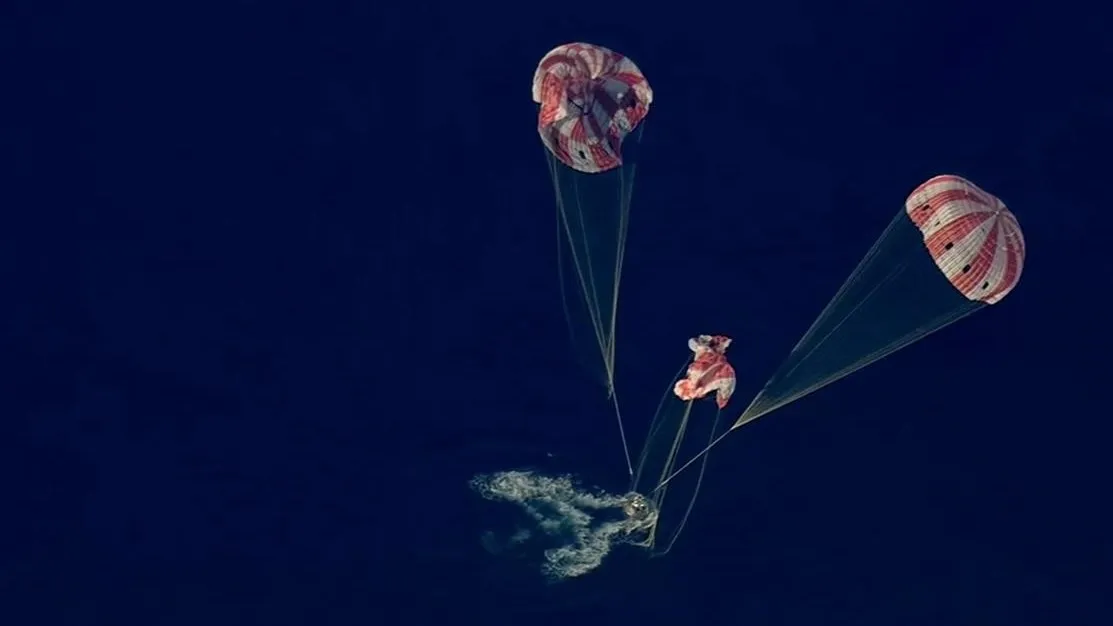
Four astronauts returned after grueling lunar orbit
NASA’s Orion spacecraft hit the Pacific Ocean waters at 5:07 p.m. PDT on Friday, successfully concluding the first human voyage to the lunar vicinity in over five decades. The capsule, named Integrity, executed a perfect landing off the coast of San Diego after a high-stakes descent through the atmosphere. Recovery teams from the U.S. Navy and NASA immediately moved to retrieve the four-person crew from the bobbing vehicle.
Technical Feats in Deep Space
Commander Reid Wiseman, Pilot Victor Glover, and Mission Specialists Christina Koch and Jeremy Hansen traveled further into space than any humans in history. During their ten-day trek, they looped around the far side of the moon, reaching a distance of 252,760 miles from Earth. This mission served as a vital validation of the Space Launch System (SLS) and Orion’s life-support systems, ensuring they can protect crews on much longer journeys.
Surviving the Fire of Reentry
Entering the atmosphere required the spacecraft to endure friction-induced temperatures reaching 5,000 degrees Fahrenheit. Traveling at nearly 25,000 mph, the vehicle used a "skip" maneuver to bleed off speed before deploying its eleven-parachute sequence. While the 1972 Apollo 17 mission marked the last time humans returned from the moon, this 2026 return utilizes modern heat-shield technology specifically designed to handle the intense thermal loads of deep-space arrivals.
Image Coutesy: Scientific American, NASA