

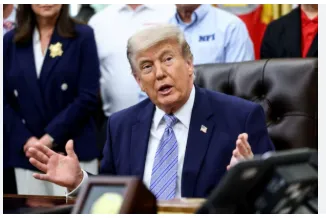
Washington, May 25: US President Donald Trump on Monday said that any potential agreement between Washington and Tehran would either be a “great and meaningful” deal or there would be “no deal at all,” as diplomatic negotiations between the two sides continue without a final breakthrough.
Posting on his social media platform Truth Social, Trump stressed that the proposed agreement with Iran was still under negotiation and would only move forward if it aligned with his administration’s conditions.
“The deal with Iran will either be a great and meaningful one, or there will be no deal,” Trump wrote, reiterating his hardline position on the ongoing diplomatic talks.
The US President also used the post to criticise political opponents in both the Democratic Party and within Republican circles, accusing them of misrepresenting the status of the negotiations. Trump said many critics were commenting on issues “that haven’t even been negotiated yet.”
“I laugh at all of the Dumocrats, RINOS, and Fools who know nothing about the potential deal I am making with Iran,” Trump said, while also describing his critics as “losers” who promote “division and loss.”
Trump further claimed that any future agreement with Tehran would be fundamentally different from the 2015 nuclear accord, formally known as the Joint Comprehensive Plan of Action, negotiated during the administration of former US President Barack Obama.
Calling the earlier pact a “disaster,” Trump repeated his longstanding criticism that the agreement created what he described as a pathway for Iran to develop nuclear weapons. Trump had withdrawn the United States from the accord in 2018, arguing that it failed to impose permanent restrictions on Tehran’s nuclear programme.
“It will be the exact opposite of the JCPOA disaster negotiated by the failed Obama Administration, which was a direct and open path to a Nuclear Weapon for Iran. No, I don’t do deals like that!” Trump added.
US Secretary of State Marco Rubio also echoed Washington’s firm position during the ongoing negotiations.
Meanwhile, Iran’s Foreign Ministry spokesperson Esmaeil Baghaei said on Monday that progress had been made on several issues included in a proposed 14-point memorandum of understanding between the two sides, though he cautioned that a final agreement was still far from complete.
According to Baghaei, the draft framework mainly focuses on ending the conflict and lifting the US naval blockade in return for Tehran ensuring safe passage through the Strait of Hormuz.
However, several contentious issues continue to remain unresolved, including Iran’s nuclear programme, Israel’s military operations in Lebanon involving the Iranian-backed Hezbollah group, Tehran’s demand for sanctions relief, and the release of frozen Iranian assets.
Despite these differences, officials from both sides have indicated that discussions on a memorandum of understanding are progressing. The proposed framework is expected to pause hostilities and provide negotiators with a 60-day window to reach a comprehensive agreement.
Senior Iranian diplomat Hossein Nooshabadi told ISNA news agency that the possible agreement could include an end to hostilities across multiple fronts, including Lebanon, the release of blocked Iranian assets, the lifting of the US naval blockade, reopening of the Strait of Hormuz, withdrawal of US forces from areas near Iran, and freedom for Tehran to export its oil.
Nooshabadi, however, underlined a major sticking point in the negotiations, stating that Iran’s draft proposal for an initial agreement does not include any commitments related to its nuclear programme.( With Agency Input)