


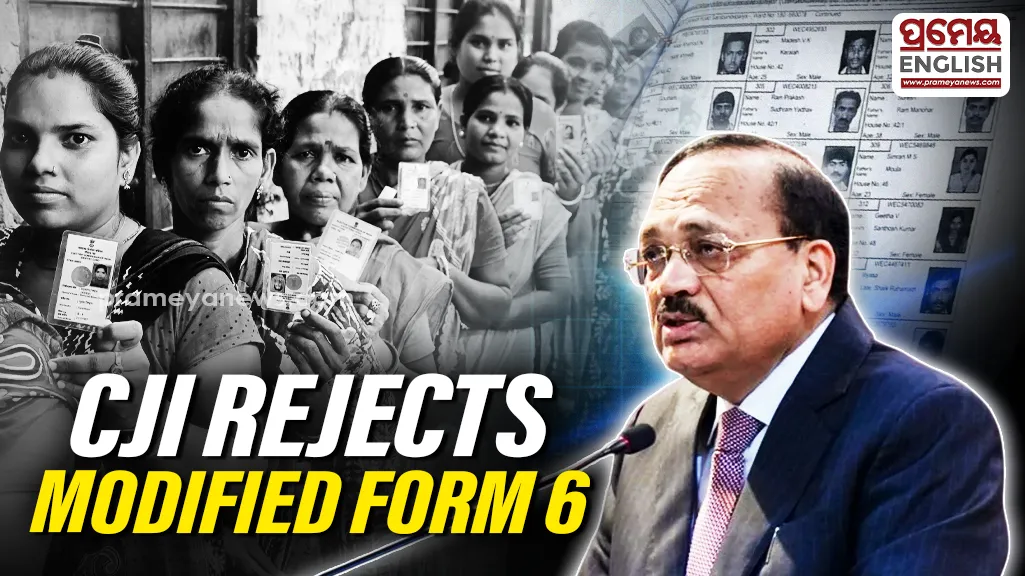
New Delhi, October 5: The Supreme Court on Monday made it clear that it had not approved any modified version of Form 6, used for enrolling new voters in electoral rolls during the Special Intensive Revision (SIR).
Chief Justice of India Surya Kant observed while hearing a petition seeking the suspension of Chief Election Commissioner Gyanesh Kumar over allegations that key decisions relating to the SIR exercise were taken unilaterally.
“Any modified Form 6 has not been approved by us. Let’s be clear. When the record is produced, we would like to see who has modified it,” CJI Kant observed during the hearing.
The observation came against the backdrop of a September 26 press statement issued by the Election Commission of India (ECI), which had stated that the declaration attached to Form 6 for the SIR had been upheld by the Supreme Court, while the forms prescribed under the Registration of Electors Rules, 1960, would be used during the non-SIR period.
The Supreme Court's observation triggered sharp political reactions.
Congress MP Jairam Ramesh alleged that CEC Gyanesh Kumar had misrepresented the court's position. He claimed that Form 6 had been deliberately modified to target young voters.
Karnataka Home Minister Priyank Kharge also accused the CEC of misrepresenting proceedings before the apex court. He questioned whether citizens could trust the Election Commission if court proceedings were allegedly being presented inaccurately.
CJP activist Ashutosh Ranka, meanwhile, claimed that the Election Commission had removed its September 26 press statement, which had referred to the Supreme Court's position on Form 6.
SC refuses immediate suspension of CEC
The Supreme Court also declined to pass an ex-parte interim order seeking the immediate suspension of CEC Gyanesh Kumar, holding that the Election Commission and other respondents must first be heard.
A bench comprising CJI Surya Kant and Justices Joymalya Bagchi and V Mohana issued notices to the Centre, Election Commission of India, CEC Gyanesh Kumar, Election Commissioners Sukhbir Singh Sandhu and Vivek Joshi, Deputy Election Commissioner Maneesh Garg and DG (IT) Seema Khanna.
“Let’s first have authenticated information on that. We can always annul any decision,” the bench observed.
The petition relied on a report alleging that 14 crucial decisions connected with the SIR exercise were taken in the name of the Election Commission despite objections by the two other Election Commissioners.
Senior advocate Vikas Singh, appearing for petitioner Rakesh Kumar Singh, sought the immediate suspension of the CEC, arguing that the alleged unilateral decisions posed a serious threat to electoral democracy.
Referring to Section 18 of the Chief Election Commissioner and Other Election Commissioners Act, 2023, Singh submitted that the Commission's business was required to be conducted unanimously or, where there was a difference of opinion, decided by majority.
When Singh sought the suspension of the CEC, the bench questioned the practical implications of such an order.
“Who will conduct the elections?” the bench asked.
Singh submitted that the other two Election Commissioners could discharge the functions of the Commission.
The bench, however, said it would first examine the allegations after receiving responses from the respondents.
Court seeks authenticated records
CJI Kant emphasised that the statutory framework governing the Commission was mandatory and said that any violation could be addressed by the court.
“If there is any violation, we will undo,” he observed.
Justice Bagchi questioned whether the court could grant the relief sought without first hearing the ECI. He indicated that if the records ultimately established that decisions were taken without the required consensus or majority, the court could declare them ultra vires.
The CJI also cautioned that the court could not pass an order solely on the basis of newspaper reports and stressed the need for authenticated information.
The petition challenges the functioning of the ECI, alleging that powers vested in the multi-member constitutional body were being exercised without following the collective decision-making mechanism prescribed by law.
It contends that the CEC, despite being the Chairman of the Commission, cannot individually exercise powers vested under Article 324 in the Election Commission as a constitutional body.
Allegations over Form 6 and electoral-roll systems
The petition refers to at least 14 contemporaneous objections allegedly recorded by Election Commissioners Sukhbir Singh Sandhu and Vivek Joshi between October 2025 and August 2026.
The objections reportedly include allegations that communications were issued in the name of the ECI without Commission approval, agendas and minutes of meetings were not circulated for more than a year, and changes were made to electoral-roll systems without the participation or approval of the other two Commissioners.
A major grievance relates to the alteration of Form 6 during the SIR.
According to the petition, Commissioner Joshi had objected that the form could not be modified to require SIR-related disclosures without an amendment to the Registration of Electors Rules, 1960. The objection was subsequently endorsed by Sandhu, the petition claims.
The plea also raises concerns over the alleged centralisation of the electoral-roll database and access to ERONet/ECINet by statutory field-level authorities.
Joshi had reportedly proposed an independent audit of database access credentials, while Sandhu subsequently questioned the authority of the ECI's Director General (IT) to restrict access available to statutory electoral officers.
Another issue highlighted in the petition concerns appeals filed in the name of the ECI before West Bengal Appellate Tribunals against voters whose inclusion in the electoral rolls had been directed by judicial officers.
Sandhu allegedly questioned who had authorised the filing of those appeals and under what legal authority.
Petition seeks safeguards for electoral data
The petition also relies on Section 18 of the Chief Election Commissioner and Other Election Commissioners Act, 2023, which provides that the Commission's business should, as far as possible, be transacted unanimously and, where members differ, decided by majority.
Among the interim reliefs sought are preservation of electoral-roll data and audit trails, a direction restraining further substantive alteration of Form 6, and safeguards against irreversible changes to electoral-roll data while the matter is pending.
The petitioner has also sought an interim direction restraining Gyanesh Kumar from exercising the functions of CEC and requiring the Commission's business to be conducted by the other two Election Commissioners.
The Supreme Court, however, has so far refrained from granting any such interim relief and has sought responses from the Centre, the Election Commission and the other respondents before considering the allegations.