

.webp)

Apple enters folding phone territory to challenge Samsung dominance
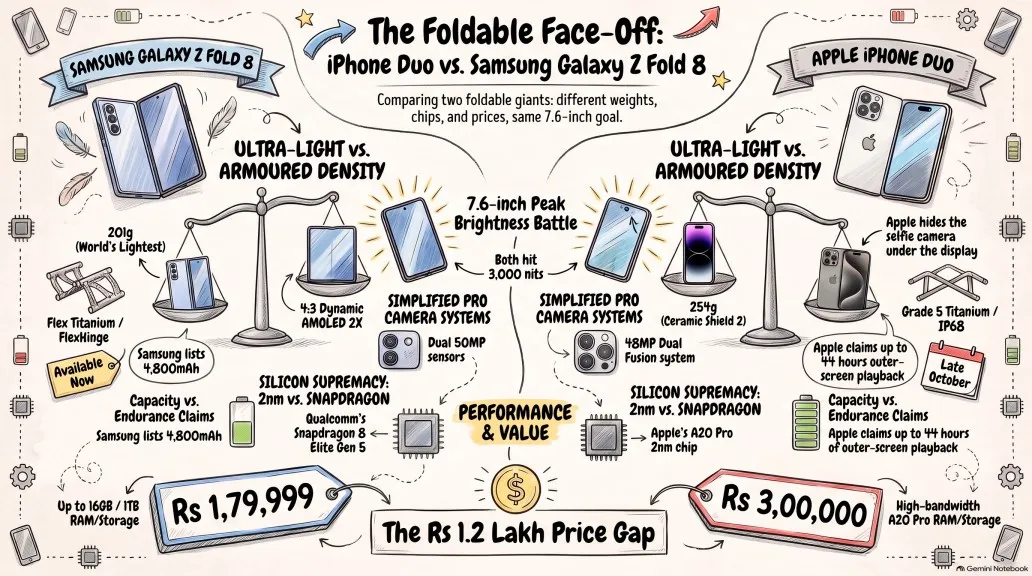
Apple finally debuted its highly anticipated folding smartphone to challenge established rivals in a rapidly growing category. Launching alongside standard flagship models, this new device commands an eye-watering Rs 3 lakh price tag in India. Its biggest rival, Samsung Galaxy Z Fold 8, offers similar high-end features but costs significantly less. For nearly seven years, folding devices evolved largely without Apple, making this late entry a major shift for global mobile technology. Consumers eager to buy a high-end device will naturally wonder how these two formidable competitors compare across various metrics. You cannot purchase Apple's offering until late October, while its Korean rival remains available right now. Let us evaluate their specifications, distinct features, hardware capabilities, and overall value.
Also Read: New Delhi Prepares for Crucial Modi Xi Bilateral Meeting as Chinese Leader Lands for BRICS Summit
Design Weight And Build Quality
Samsung created a notably lighter device, bringing the total weight down to only 201g. Built with Flex Titanium materials and a robust Armour FlexHinge, it measures just 4.5mm thick when completely open and 9.7mm when folded shut. Its 5.5-inch cover screen uses a 16:10 aspect ratio, successfully mimicking standard phone dimensions for comfortable daily use.
Apple engineered a much heavier product that tips the scales at 254g. It features a premium Grade 5 titanium frame, an official IP68 rating for dust and water resistance, and toughened Ceramic Shield glass protecting both sides. Its outer display spans a compact 5.4 inches. Buyers prioritising extreme pocketability will prefer Samsung, whereas those who want a dense, highly armoured feel might choose Apple.
Screen Size and Display Innovation
Both manufacturers offer an identical 7.6-inch inner display size, but they engineered their visual experiences completely differently. Samsung optimised its inner panel to a practical 4:3 aspect ratio. This 120Hz QXGA+ Dynamic AMOLED 2X screen remains incredibly vibrant, capable of reaching 3,000 nits of peak brightness during intense outdoor use.
Apple widened its internal screen rather than opting for a square format. This Super Retina XDR panel provides 50 percent more viewing area than an iPhone 18 Pro Max. It also reaches 3,000 nits of brightness and supports ProMotion refresh rates up to 120Hz. Apple successfully hid its selfie camera entirely beneath the display, eliminating any punch-hole cutout that might distract users. A special nano-texture coating further reduces crease visibility and glare.
📲Follow our WhatsApp Channel for the latest news, breaking updates, and important headlines. Stay connected with us for more updates!
Processing Power and Performance Metrics
Hardware enthusiasts will certainly appreciate this silicon rivalry. Apple utilizes its brand new A20 Pro chip, manufactured on an advanced 2-nanometre process. This setup includes a six-core CPU, a seven-core GPU, and a powerful dual 16-core Neural Engine. It also boasts 50 percent more memory bandwidth than earlier generations. Engineers added a custom vapour chamber cooling system to prevent thermal throttling while running intensive applications on the large screen.
Samsung relies on Qualcomm's Snapdragon 8 Elite Gen 5 processor, supporting up to 16GB of RAM and offering up to 1TB of internal storage for premium models. Both processors deliver elite computing speeds, meaning your final choice depends more on software ecosystem preference than raw benchmark numbers.
Camera Capabilities and Battery Life
Apple equipped its foldable with a capable 48-megapixel Dual Fusion system. This setup features a 48-megapixel main camera providing 2x optical-quality zoom, alongside a 48-megapixel ultra-wide lens boasting a 120-degree field of view. Users can prop the device up and use the outer screen as a viewfinder to capture high-quality selfies using the primary lenses. Samsung uses a capable dual 50-megapixel camera system, reserving its elaborate triple-lens layout exclusively for the Ultra variant.
Also Read: Lord Jagannath’s land in Pak? Odisha Law Minister remark raises mystery over deity’s properties
Battery measurement varies wildly between both companies. Apple avoids sharing exact capacity numbers, claiming up to 31 hours of inner display video playback and 44 hours on the outer screen. It achieves a 50 percent charge in about 20 minutes via fast wired charging. Samsung provides a concrete 4,800mAh battery capacity that supports rapid 45W charging.
Pricing Tiers and Final Thoughts
Samsung starts selling its 12GB RAM and 256GB storage model for Rs 1,79,999. The top-tier 16GB RAM and 1TB storage variant climbs to Rs 2,39,999. Apple demands almost Rs 3 lakh for its base configuration in India. This surprising pricing strategy makes the most expensive Samsung option about Rs 60,000 cheaper than the most affordable Apple model. Buyers must decide if they want a refined, affordable wide-screen format or if they prefer paying a true premium for Apple hardware.

iPhone Duo vs Galaxy Z Fold 8
.webp)