
.webp)

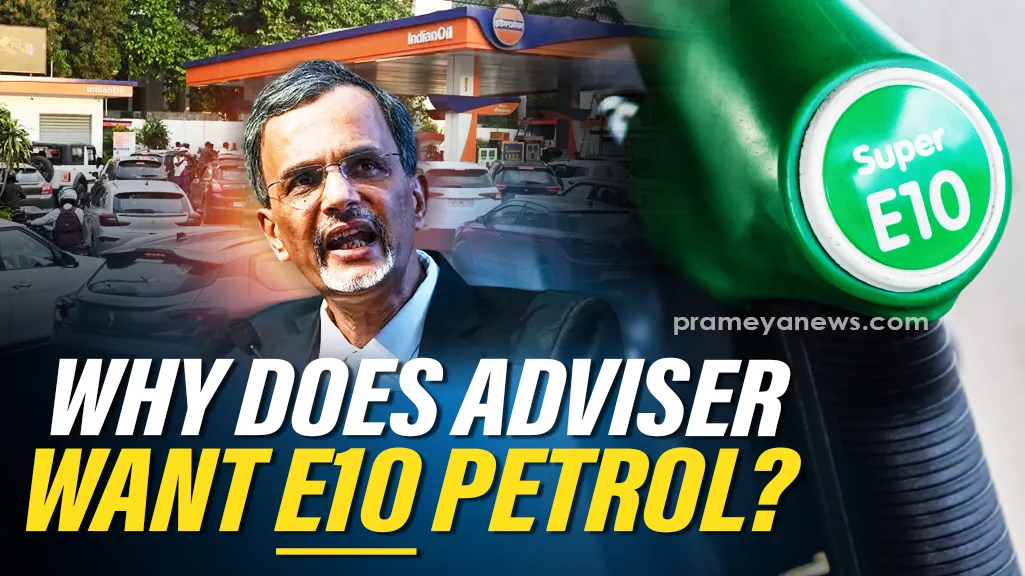
Top economic advisers recommend restoring E10 for older vehicles.
Chief Economic Adviser V Anantha Nageswaran and consultant Akash Poojari from the Department of Economic Affairs have proposed restoring E10 petrol for older vehicles. They also urged policymakers to evaluate the critical trade-offs between food, animal feed, and water resources before pushing petrol blending targets beyond the current 20 percent mark.
India recently achieved its E20 blending target well ahead of the original deadline, largely driven by rapid expansion in domestic distilleries and government energy transition mandates. However, the authors argue that moving toward higher blends like E27 and E30 will severely strain agricultural resources. Diverting crops such as sugarcane, maize, and rice to fuel production can directly affect food prices. Recently, 3 million tonnes of sugar, representing about 10 percent of annual domestic output, was diverted to produce ethanol in a single season. Increasing this demand forces maize, a vital component for poultry and livestock feed, to become a primary fuel source.
Water Trade Offs and Resource Limits
Producing ethanol demands significant water, especially when cultivating water-intensive crops like sugarcane across different states. Committing large tracts of agricultural land and water strictly to fuel production creates permanent changes in farming practices. Reversing these land use decisions becomes nearly impossible once distilleries are built and supply chains are established. The authors stress that energy security gains must not outweigh these deeply embedded environmental and economic costs.
Protecting Older Two Wheelers
Roughly 75 million to 80 million older two-wheelers remain on Indian roads today. These pre-BS-IV vehicles run on carburettors that cannot adjust fuel-air mixtures for higher oxygen levels in E20 petrol. These older engines run hotter and suffer damage to outdated rubber components. While retrofitting remains an option, the sheer scale of modifying millions of vehicles makes immediate implementation difficult. Restoring E10 petrol alongside E20 provides a safe interim solution for these riders, ultimately reducing overall ethanol consumption while protecting legacy engines.
.webp)