


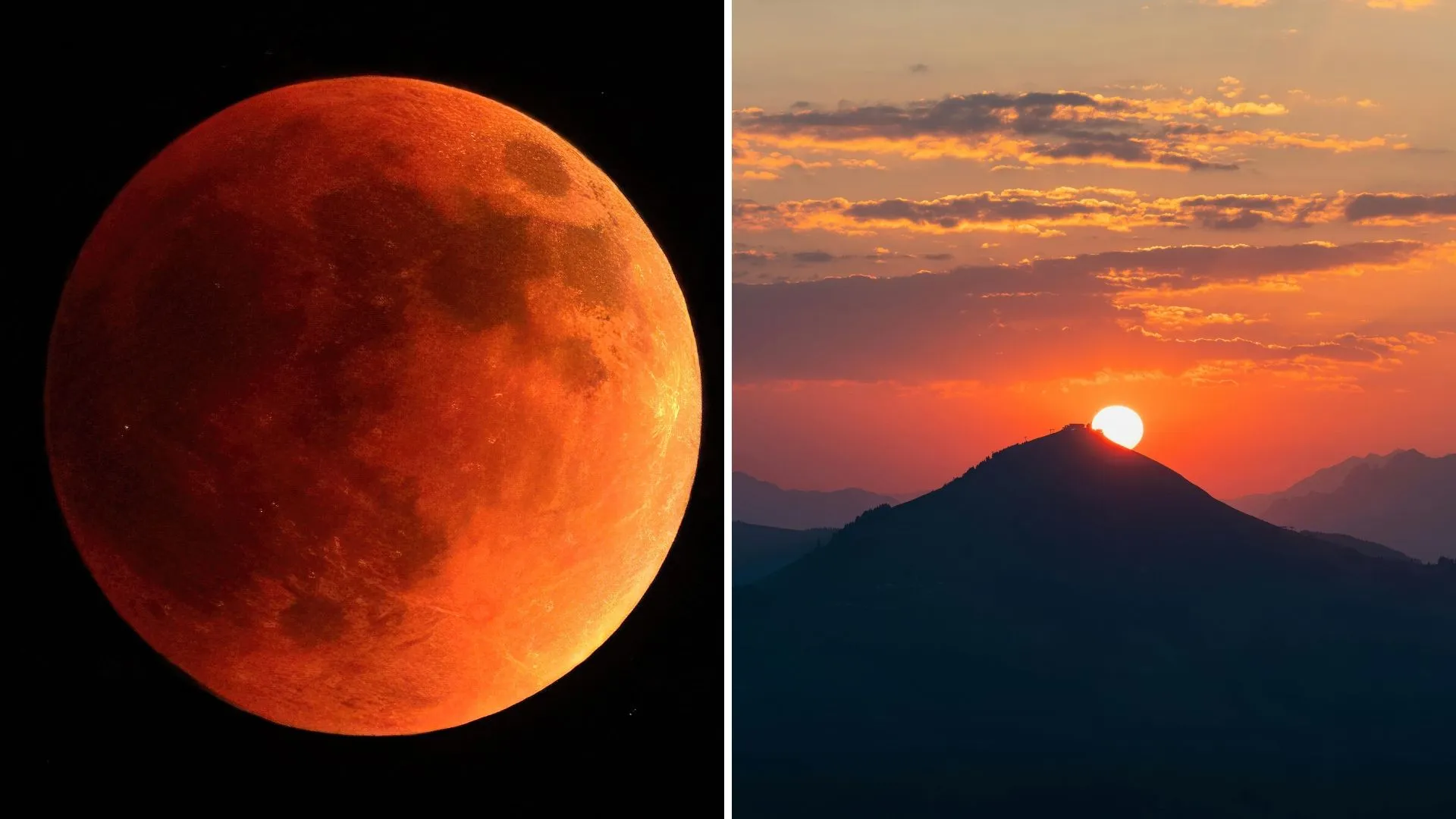
A rare celestial spectacle will light up the skies on March 3, 2026, as a total lunar eclipse popularly known in India as Chandra Grahan coincides with the vibrant Hindu festival of Holi. The astronomical event is expected to be visible across large parts of India during the early evening hours, with the Moon rising in many regions already glowing red.
Chandra Grahan 2026: Date and Timings in India
The first lunar eclipse of 2026 will occur on Tuesday, March 3. In India, the eclipse will begin at approximately 3:20 PM IST and conclude at 6:46 PM IST, lasting a total of 3 hours and 27 minutes.
The most favorable viewing window is expected between 6:33 PM and 6:40 PM IST, shortly before the eclipse ends at around 6:47 PM IST.
Sutak Period
As per traditional Hindu beliefs, the Sutak kaal - an inauspicious period observed before eclipses — will begin at 6:23 AM on March 3 and continue until the eclipse concludes in the evening.
Visibility across India
Since the Moon will rise later in the evening in most parts of India, only the final phase of the eclipse is likely to be visible. Observers can step outside at dusk and look toward the eastern horizon to witness the event, with no late-night viewing required.
Major cities including Delhi, Mumbai, Bengaluru, and Chennai are expected to see the eclipse between 6:20 PM and 6:30 PM IST.
Better visibility is anticipated in northeastern states such as Assam, Arunachal Pradesh, Meghalaya, and West Bengal, where the Moon rises earlier, allowing residents to witness a longer portion of the eclipse.
Why the Moon turns red
A total lunar eclipse occurs when the Earth comes directly between the Sun and the Moon, casting its shadow on the lunar surface. As the full Moon moves into Earth’s deepest shadow, it often takes on a reddish hue - commonly referred to as a “Blood Moon.” This striking color appears because sunlight bends through Earth’s atmosphere and filters out shorter blue wavelengths, leaving behind red and orange tones that illuminate the Moon.
Global visibility
According to astronomical data from Time and Date, at least part of the total lunar eclipse will be visible across Europe, Asia, Australia, North America, South America, and over the Pacific, Atlantic, and Indian Oceans, as well as in polar regions including the Arctic and Antarctica.
Best viewing tips
Step outside and find a clear view of the eastern horizon at dusk.
Avoid bright city lights where possible.
Binoculars or a telescope can enhance details, though they are not necessary.
Rooftops, beaches, and hilltops are ideal locations for viewing.
With its rare alignment alongside Holi celebrations, the March 3, 2026 total lunar eclipse promises to be both a cultural and astronomical highlight for skywatchers in India and around the world.