.webp)


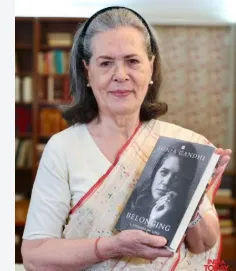
New Delhi, Nov 10: Congress Parliamentary Party (CPP) Chairperson Sonia Gandhi has recalled the circumstances that led her to enter active politics, saying the BJP-RSS and their affiliates were advancing their “divisive agenda” and that the deteriorating condition of the Congress made her increasingly concerned about the party's future.
In her memoir, 'Belonging: A Journey of Love' released today, Sonia Gandhi talked about the political developments following the Congress's disappointing performance after the 1996 general elections, the growing divisions within the party and the increasing pressure on her to take over its leadership.
Recalling the political situation in the country in the 1990s, she said there had been clear indications for several years that the Bharatiya Janata Party -- Rashtriya Swayamsevak Sangh and their affiliated organisations were pursuing a "divisive agenda".
In her memoir, Sonia Gandhi referred to the demolition of the Babri Masjid in 1992 and the subsequent communal violence as clear indications of the growing political influence of the BJP-RSS and their affiliates.
"There had been for several years clear indications that the BJP-RSS and their affiliates were single-mindedly advancing their divisive agenda. The tragic demolition of the Babri Masjid in 1992 and the ensuing spiral of communal violence were definite pointers: Those outfits were no longer going to work behind the scenes. The BJP was drawing closer to its dream of absolute power," she wrote in her memoir.
She further said that the BJP, along with its allies, had defeated the Congress in 1996, gaining confidence to openly advance its agenda and create opposition to the secular values and pro-poor policies to which the Congress was committed.
"With its allies it had defeated the Congress in 1996, gaining more confidence to spread its venom openly and to create a groundswell against the secular values and pro-poor policies to which our party was pledged," she wrote.
Sonia Gandhi also recalled the difficult period within the Congress following the 1996 general elections, when the party failed to form a government on its own and was grappling with internal splits and factional disputes.
She said that in 1995, she had been asked to support a particular group comprising senior Congress leaders Arjun Singh, N D Tiwari and Mohsina Kidwai, who had served the party for decades and held important positions and ministerial portfolios. However, she refused.
"In 1995 I had been asked to support one particular group, in which the main actors were Arjun Singh, N D Tiwari, and Mohsina Kidwai, who’d been party members for decades and had held important positions and ministries. I had refused," she wrote.
She said the leaders subsequently broke away and formed another party. "The following year, senior Tamil leaders G K Moopanar and P C Chidambaram, along with Madhavrao Scindia, who had joined the Congress in 1980, also left the party and established separate political outfits. In 1997, Mamata Banerjee left the Congress following differences with the state leadership and formed the Trinamool Congress," she stated.
Sonia Gandhi said she became a primary member of the Congress in 1997 after then party president Sitaram Kesri invited her to the party's 80th Plenary Session in Calcutta. However, as the party's situation continued to worsen, pressure on her to assume its leadership increased.
"I had become a primary member in 1997 when I was invited by the Congress President Sitaram Kesri to the party’s 80th Plenary Session in Calcutta, but as the party’s situation seemed to be worsening, the pressure on me was increasing to take over its leadership. I began to feel increasingly perturbed," she wrote.
Sonia Gandhi entered active politics later in 1998 and subsequently took over as Congress president, leading the party through a crucial phase of its political journey.
Describing her state of mind during the period, she said she had become increasingly agitated and worried about the future of the Congress. "I began to feel agitated, brooding on what was going on in the Congress Party, worrying about its fate," she wrote.
Sonia Gandhi further described how she turned to reading the Bhagavad Gita during this period, with someone translating the text and explaining its meaning to her.
Recalling the message of the Gita, she said Krishna's advice to Arjuna to perform his dharma without being concerned about the fruits of his actions helped her overcome her doubts.
"Krishna has expounded the message of the Gita: Perform your dharma without regard for the fruit of your action. Arjuna, the Pandava prince, declares that his illusion is now dispelled; he is restored to himself, firm and free from all doubts, and ready to play his part in the battle," she wrote in her memoir.
Reflecting on the moment when she arrived at her decision, Sonia Gandhi said the teachings helped her find clarity about the responsibility she needed to undertake. "Something awoke in me: I was sure. I had the answer to my own doubts and questions. I had to step out and go where my duty called. And I did," she wrote.
She also recalled that her children, Rahul Gandhi and Priyanka Gandhi, were aware of her restlessness and feared that she might get drawn into politics. "Having already lost their grandmother and father, they did not want to lose her as well," she wrote.
Also Read: Public servant in judicial custody for over 48 hrs deemed suspended, says SC
Sonia Gandhi memoir 'Belonging: A Journey of Love' offers a glimpse into some of the most defining moments in the Gandhi family's history, including the death of Sanjay Gandhi in a plane crash, the assassination of former Prime Minister Indira Gandhi in 1984, and the killing of former Prime Minister Rajiv Gandhi in 1991.
It also revisits key political milestones in Sonia Gandhi's journey, including the Congress-led alliance's victory in the 2004 general elections. (ANI)
.webp)