
.webp)


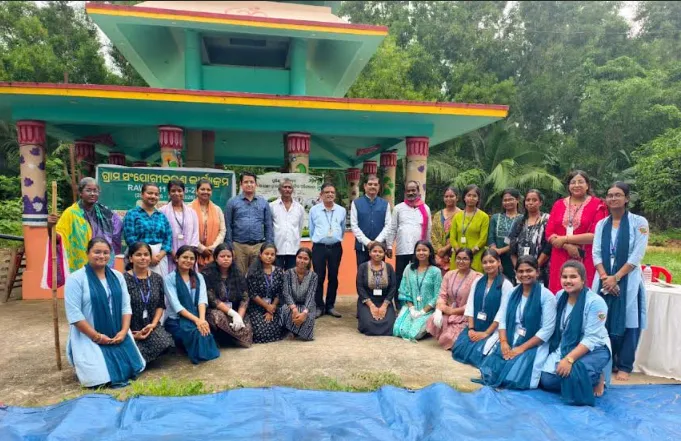
Bhubaneswar, Aug. 22: Students studying agricultural science at the SOA Deemed to be University here received intensive and meaningful exposure to rural realities, farming systems and livelihood challenges through the Village Attachment Program organised under the Rural Agricultural Work Experience (RAWE) initiative undertaken in 11 villages across three blocks of Khordha district recently.
Working closely with farmers, rural households and other community stakeholders, students of the Institute of Agricultural Sciences (IAS), faculty of agricultural sciences of SOA, the students undertook field-based interventions in the 11 villages while conducting 32 demonstration-based training programs and 16 awareness initiatives.
The RAWE program is an essential part of the undergraduate agricultural curriculum under the initiative of the Indian Council of Agricultural Research (ICAR).
The program was designed to bridge the gap between classroom learning and field realities enabling students to understand agriculture and rural livelihoods from the perspective of the farming community. A major component of the program was the systematic assessment of the agricultural and livelihood conditions of the adopted villages through Agro-Ecosystem Analysis (AESA).
Students studied the existing farming systems, cropping patterns, resource availability, livelihood activities, technological practices, production constraints and other factors influencing the agricultural economy of the villages.
Based on the findings of the field assessment, the students identified subject-wise interventions and prepared comprehensive Village Action Plans (VAPs) for the villages. The plans were developed by taking into consideration the specific needs, problems, resources and opportunities available at the village level under the supervision of the Faculty Committee.
One of the major achievements of the program was the organisation of 32 demonstration-based training efforts on need-based and problem-oriented themes identified during the students’ interaction with farmers and villagers. The training programs were designed to provide practical and easily adoptable solutions to local agricultural problems.
Students took an active role in conducting the programs and, in several activities, acted as student experts, demonstrating agricultural practices and technologies before farmers while explaining their practical applications. The approach enabled students to move beyond conventional classroom-based learning and get first-hand knowledge of the responsibilities of agricultural extension professionals.
The students also conducted 16 awareness programs addressing locally relevant and problem-oriented issues.
The topics were selected based on the needs identified through village-level interactions and Agro-Ecosystem Analysis.
It provided the students an opportunity to communicate scientific information in a simple and locally relevant manner while understanding farmers’ perceptions, indigenous knowledge and field-level constraints.
The Village Attachment Program also enabled the students to experience the complete process of agricultural extension-from identifying community needs and analysing field problems to developing interventions, preparing action plans and communicating appropriate technologies.
The program also helped students develop important professional skills such as communication, leadership, teamwork, participatory problem identification, community mobilisation and technology dissemination. Their direct engagement with farmers enabled them to appreciate the complexity of farming decisions and the importance of developing location-specific and farmer-centric solutions.
SOA Vice-Chancellor Prof. Pradipta Kumar Nanda appreciated the efforts of the students and the faculty of Agricultural Sciences in successfully implementing the Village Attachment Program. He emphasised the importance of linking higher agricultural education with rural communities and said such initiatives provided the students with valuable field experience while strengthening the university’s engagement with farmers.
Prof. Santosh Kumar Rout, Dean of IAS, described field-based learning as an essential component of agricultural education as it enabled students to understand the realities and challenges faced by farmers. He congratulated the students for actively engaging with the communities and translating their academic knowledge into practical interventions.
Prof. Bibudha Parasar, the institution’s head of Department of Agricultural Extension and Communication, highlighted the importance of participatory learning and farmer interaction in agricultural extension. He said the Village Attachment Programme provided students with an opportunity to understand the needs of rural communities while facilitating a two-way exchange of knowledge between farmers and the university.
The program successfully transformed the concept of ‘Classroom to Community’ and ‘Knowledge to Action’ into practice, Dr. Anshuman Jena, Chairman, RAWE, said.
Mr. Jena said the program helped students to develop the competence required of future agricultural extension professionals.
.webp)