
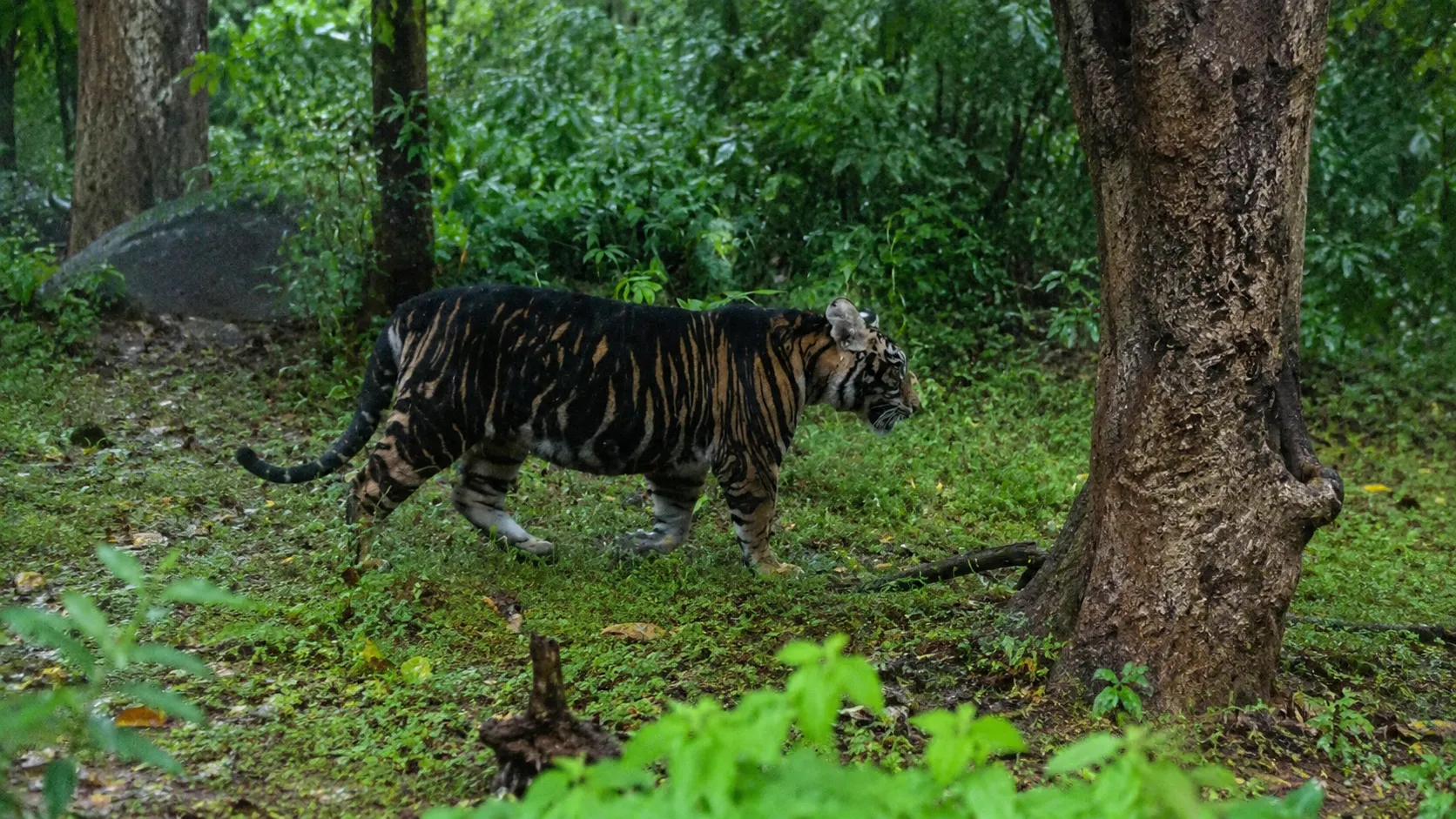
Baripada, August 8: A rare melanistic tigress was found dead in the Upper Barahakamuda Range of the Similipal South Division, marking a significant loss to wildlife conservation in Odisha.
The carcass of the approximately five-year-old tigress was discovered by patrolling forest staff at around 5 pm on August 6. Soon after receiving the information, the Field Director of Similipal Tiger Reserve reached the spot and initiated an investigation.
In accordance with the Standard Operating Procedure (SOP) of the National Tiger Conservation Authority (NTCA), a team of experts conducted the post-mortem examination on August 7.
The expert team included the Field Director of Similipal Tiger Reserve, a veterinary doctor, a veterinarian from the Wildlife Trust of India, a veterinary doctor from Thakurmunda and an Assistant Professor from Maharashtra.
The preliminary examination found no visible external injury marks on the tigress. However, to determine the exact cause of death, various biological samples were collected and sent to the Centre for Wildlife Health at OUAT, Bhubaneswar, for detailed laboratory analysis.
Similipal Tiger Reserve Field Director Dr Prakash Chandra Gogineni said the exact cause of death would be established only after the laboratory reports are received.
Following the post-mortem examination, the carcass was cremated in accordance with prescribed wildlife protocols. The entire process, from the post-mortem examination to the cremation, was documented through photographs and video recordings.
Melanistic tigers, commonly referred to as black tigers, are extremely rare and are known for their distinctive dark coat caused by a genetic condition known as melanism. Similipal is globally recognised as the only known habitat where such melanistic tigers occur naturally.
The Forest Department termed the death a major loss for tiger conservation, particularly because of the unique melanistic tiger population found in Similipal.