


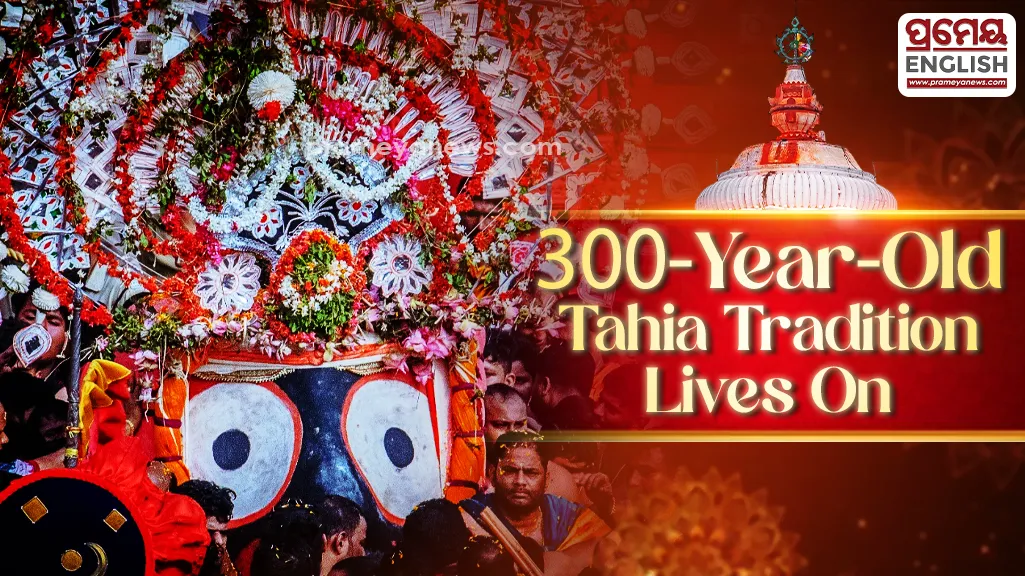
Puri, Jul 22: Every year during the Rath Yatra in Puri, one of the most striking sights is the magnificent Tahia—the elaborate floral headgear adorning Lord Jagannath and Lord Balabhadra during the sacred Pahandi procession. While the Tahia is an integral part of the festival today, few know the fascinating legends behind its origin and the centuries-old tradition that continues to this day.
According to a popular legend, the tradition dates back to the reign of Gajapati Purushottama Deva. During the annual Chandan Yatra, the deities were being taken on a ceremonial boat ride at Narendra Tank when a violent storm caused the boat to capsize. The movable idol of Lord Madanmohan was submerged in the water.
As the deity could not be immediately brought back to the Jagannath Temple, the daily rituals of Lord Jagannath came to a standstill. At this critical moment, the head of Raghab Das Math offered an identical idol of Lord Madanmohan, which was worshipped in the monastery, to ensure that the temple rituals continued uninterrupted.
In gratitude, Gajapati Purushottama Deva granted several special ritual privileges to the monastery, one of which was the sacred Tahia Seva.
Another legend associates the tradition with Raghab Das, a revered saint and ardent devotee of Lord Jagannath. He lived in a small palm-leaf hut near the seashore, where storms frequently damaged his dwelling.
It is believed that a temple servitor once hung one of Lord Jagannath's blessed floral ornaments on the saint's hut. Miraculously, the hut remained unharmed despite heavy rain and strong winds. Deeply moved by this divine grace, Raghab Das began offering specially crafted Tahia to the deities every year as an expression of devotion.
Since then, Raghab Das Math has continued this sacred tradition uninterrupted for nearly 300 years.
Jagannath culture researcher Dr. Bhaskar Mishra believes the Tahia tradition originated in the early eighteenth century. He points out that ancient scriptures such as the Niladri Mahodaya and Bamadeva Samhita, which describe the rituals of the Gundicha Yatra in detail, make no mention of the Tahia. This suggests that the tradition evolved later and has since become an inseparable part of Rath Yatra rituals.
Different Tahias for Srimandir and Gundicha Temple
Interestingly, separate Tahias are prepared for the Jagannath Temple and the Gundicha Temple because the entrance and exit gates of the two shrines differ in size.
For the Srimandir, the Tahia measures approximately 4½ hands in length and 6 hands in width, while for the Gundicha Temple, it is slightly smaller at 3½ hands in length and 6 hands in width to facilitate the deities' movement through the temple gates.
On the day of the Gundicha Yatra, the Tahias are ceremonially brought into the Jagannath Temple through the southern gate by servitors of Raghab Das Math and kept at the Lakshmi Temple Jagamohan. Once the deities reach the Satapahacha during the Pahandi procession, the Tahias are handed over to the Palia Khuntia servitors, who then pass them to the Daitapati servitors. The Daitapatis ceremonially tie the sacred floral crowns on the heads of Lord Jagannath and Lord Balabhadra before the procession proceeds.
The Tahia remains one of the most distinctive symbols of the Rath Yatra, representing centuries of devotion, tradition and the enduring spiritual heritage of Lord Jagannath.