.webp)

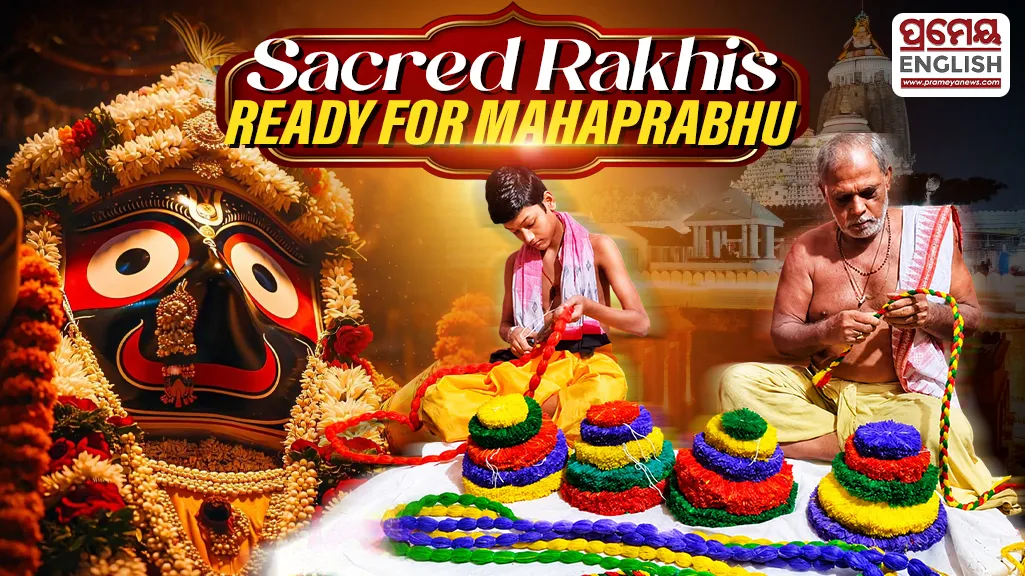
Puri, August 27: Preparations are underway at the Shree Jagannath Temple for the traditional Rakhi ceremony to be observed on Gamha Purnima. The sacred Rakhis, being prepared by the temple’s Patara Bisoi servitors, have now reached the final stage.
The Rakhis are being made in four colours—red, blue, yellow and purple. On Gamha Purnima, Goddess Subhadra will symbolically tie the sacred Rakhis to her brothers, Lord Jagannath and Lord Balabhadra.
Special Rakhis for the deities are being crafted from Vasunga silk fabric by the Patara Bisoi servitors. According to temple rituals, the Rakhi-laghi ceremony is performed after the midday Dhupa ritual on Gamha Purnima. Lord Jagannath and Lord Balabhadra each adorn two Rakhis and also wear two gua mala garlands on their hands.
Lord Balabhadra’s birth ritual is also observed on the same day.
Traditional Crafting Process
As per tradition, the preparation of the deities’ Rakhis begins from Chitalagi Amavasya. The Patara Bisoi servitors make the sacred Rakhis at their homes as part of their hereditary service to the temple.
Patara Bisoi servitor Santosh Kumar Patra said he personally prepares the Rakhis and considers himself merely an instrument in the service of Lord Jagannath. He said the opportunity to serve the deities is a matter of great honour for his family, which has carried out the hereditary service for generations.
The Shree Jagannath Temple Administration provides the required quantity of Vasunga silk to the Patara Bisoi servitors. The fabric is dyed using natural colours and dried in the sun. It is then cut into specific sizes and shaped into circular layers.
Using a traditional wooden comb, the fabric is arranged into five layers to create the distinctive Rakhis. The threads used to tie the Rakhis are also made from Vasunga silk.
Four gua mala garlands are prepared using 54 areca nuts each. Lord Jagannath wears yellow and red gua mala, while Lord Balabhadra adorns blue and purple ones.
Apart from the larger Rakhis meant for the two principal deities, smaller Rakhis are also prepared from Vasunga silk. These are offered to the various subsidiary deities inside the temple as part of the traditional rituals.
.webp)