


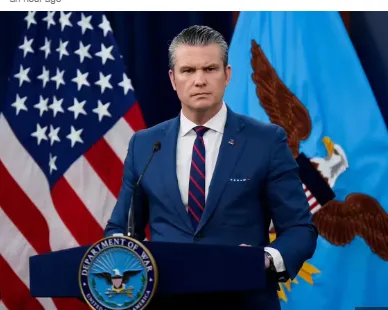
Washington, DC [US], April 8: US Secretary of War Pete Hegseth declared on Wednesday that Iran had “begged” for a ceasefire, insisting that the United States had secured a “decisive military victory” during Operation Epic Fury. Speaking to reporters at the White House following an agreement between the US and Iran for a two-week ceasefire, Hegseth emphasized the overwhelming success of the American military’s aerial campaign, which he claimed had dealt a severe blow to Iran’s strategic assets.
“President Trump made this moment happen. Iran begged for this ceasefire, and we all know it,” Hegseth said. “Operation Epic Fury was an historic and devastating victory on the battlefield. It obliterated Iran’s military, leaving it incapable of combat for years.” He added that American forces had carried out hundreds of strikes in just a matter of hours. “We launched 800 strikes on Tuesday night alone, dismantling Iran’s defense industrial base. Their factories have been destroyed,” Hegseth remarked.
The Secretary of War also suggested that Iran’s new Supreme Leader, Mojtaba Khamenei, had been injured in the campaign, though he did not provide any substantiating evidence. “Iran’s military infrastructure has been significantly damaged, and the regional balance of power has shifted as a result,” Hegseth noted. He further emphasized that while President Trump had the capacity to cripple Iran’s entire economy, he chose to show mercy, sparing targets due to Iran's acceptance of the ceasefire under intense pressure.
“The new Iranian regime realized that a deal was far better than the fate their predecessors faced,” Hegseth said. “They saw what happened to the old regime.”
Earlier, President Donald Trump had announced the suspension of the US bombing and attack campaign on Iran, agreeing to a two-week ceasefire after the Iranian government submitted a 10-point proposal. Trump, posting on Truth Social, stated that the proposal provided a foundation for future negotiations aimed at reaching a permanent peace deal while noting that the US had achieved most of its military objectives.
Trump also revealed that he had consulted with Pakistani leadership, including Prime Minister Shehbaz Sharif and Field Marshal Asim Munir, who requested a halt to the offensive. “I agree to suspend the bombing and attacks on Iran for two weeks,” Trump wrote, adding that this suspension was contingent upon Iran agreeing to the “complete, immediate, and safe opening” of the Strait of Hormuz. Trump emphasized that the military objectives had been largely met, and discussions were advancing toward a long-term peace agreement with Iran.
In response, Iranian Foreign Minister Seyed Abbas Araghchi confirmed that Iran would cease its military operations if no further attacks were launched against the country. “For a period of two weeks, safe passage through the Strait of Hormuz will be coordinated with Iran’s Armed Forces,” Araghchi stated on X (formerly Twitter). The Iranian government also made it clear that the cessation of hostilities would remain in effect only if Iran was not attacked during the ceasefire period.
As both parties adhere to the truce, the focus will now shift to diplomatic efforts. Talks between the Iranian delegation, led by Parliament Speaker Mohammad Bagher Ghalibaf, and the US team, led by Vice President JD Vance, are scheduled to take place in Islamabad on Friday. ( With Agency Input)