
.webp)


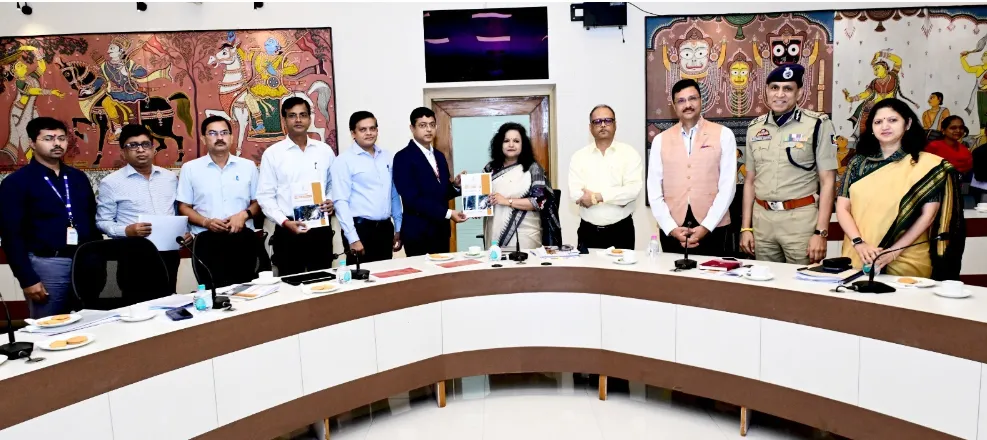
Bhubaneswar, November 5: An eight-member Inter-Ministerial Central Team, currently on a visit to Odisha to assess the damage caused by Cyclone ‘Arnab’ and the subsequent floods in several districts, participated in a preliminary damage assessment meeting at Lok Seva Bhawan here today. The meeting was organised by the Office of the Special Relief Commissioner following the team's field visits to the affected areas.
The meeting was chaired by Chief Secretary Anu Garg, while the Central Team was led by Ravi Shankar, Joint Secretary, Ministry of Home Affairs, Government of India. The team comprised senior officials and representatives from various Central Government departments and organisations, including the Department of Agriculture and Farmers Welfare, Directorate of Rice Development, Patna, Department of Expenditure under the Ministry of Finance, Ministry of Jal Shakti, Central Water Commission, Central Electricity Authority, Ministry of Road Transport and Highways, Ministry of Rural Development and National Remote Sensing Centre (NRSC), ISRO.
The Central Team had visited cyclone- and flood-affected areas of Gajapati district on November 3 and Ganjam district on November 4. During today's meeting, the members shared their field observations and findings on the extent of damage. They also held detailed discussions with the Chief Secretary, departmental Secretaries and other senior State Government officials on the impact of the cyclone and subsequent floods and the prevailing situation in the affected areas.
 During the field visits, the team observed extensive damage to crops caused by the cyclone and subsequent flooding. Several infrastructure facilities, including roads, power infrastructure, river embankments and canals under the Water Resources Department, had also sustained significant damage.
The District Collectors informed the team that additional time would be required to complete a comprehensive assessment in view of the extensive damage. The Central Team advised the State Government to conduct a house-to-house survey to ensure that all losses were properly documented. The team also assured that the Central Government would extend necessary support for reconstruction, strengthening of river embankments and other restoration activities.
The meeting also emphasised the need to raise and strengthen river embankments and canals in the affected areas. Damage to drinking water infrastructure, National Highways, roads and bridges under the Works, Rural Development and Panchayati Raj Departments was also reviewed. Although temporary repairs have been undertaken in some locations and restoration work is in progress, the need for further interventions to address long-term infrastructure requirements was highlighted.
The cyclone and floods have also caused extensive damage to fish ponds and livestock in the affected districts. Based on inputs and damage reports received from various departments, the Office of the Special Relief Commissioner prepared a consolidated assessment report and submitted it to the Central Team.
Addressing the meeting, Chief Secretary Anu Garg apprised the Central Team of Odisha's experience in managing recurring natural disasters, including cyclones and floods, since the devastating Super Cyclone of 1999. She emphasised that, as the State faces multiple natural calamities almost every year, disaster management, advance preparedness, rapid deployment of response teams, rescue operations and relief measures remain among the Government's highest priorities.
She further highlighted the State Government's continued efforts to strengthen disaster-resilient infrastructure and institutional capacities to minimise the impact of future disasters and ensure the safety of human lives and protection of property.
The meeting was attended by Deoranjan Kumar Singh, Development Commissioner-cum-Additional Chief Secretary; . Aravinda Kumar Padhee, Additional Chief Secretary, Revenue Department; Rajesh Prabhakar Patil, Special Relief Commissioner; and Secretaries and senior officials from various departments, including Revenue, Housing and Urban Development, Water Resources, Works, Agriculture, Health and Family Welfare, Rural Development, Panchayati Raj and Drinking Water, Commerce and Transport, and Energy.
.webp)