

The house, usually silent and deserted, suddenly has eight or ten vehicles parked outside. There is a crowd. A flower-decked hearse stands nearby.
“Patra uncle is gone,” says the colony grocery shopkeeper. “He had been unwell for a few days. He passed away yesterday. His only son lives outside. It was just the old couple here. Now everyone is waiting for the son and daughter-in-law to arrive.”
Just then, an elderly couple slowly walks past the shop, holding hands.
The woman carries a walking stick and wears a support belt around her waist. The man carries a bag of vegetables in his left hand. With his right, he holds his wife's hand as they move forward, one careful step at a time.
📲Follow our WhatsApp Channel for the latest news, breaking updates, and important headlines. Stay connected with us for more updates!
It is a scene increasingly common in Bhubaneswar.
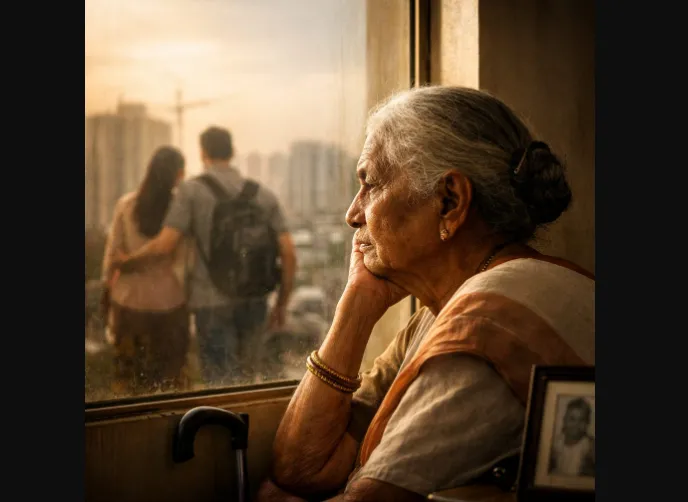
Across the city, countless elderly men and women are walking through the twilight of their lives almost alone. Their children have moved away in search of better jobs, higher salaries and brighter futures. Many have settled in Bengaluru, Pune or other cities, while others have moved overseas.
The parents stayed behind.
They may have houses, savings, pensions and property. What many lack is something money cannot easily provide—a person to sit beside them, take them to a doctor, accompany them to a temple or simply share a meal.
Houses Full of Space, Empty of People
In the affluent IRC Village area of New Bhubaneswar stands a smart four-storey building. On the ground floor live retired engineer Mishra Babu and his wife. A helper assists them with daily chores, while the other three floors are rented out.
Their days pass quietly—newspapers in the morning and television through much of the day.
There are no close relatives nearby. Their son, an IT professional, lives in Australia with his wife. Their daughter moved to Pune after marriage.
The building is full, but their home feels empty.
Official figures suggest that Bhubaneswar has around two lakh senior citizens. The number is likely higher if the elderly population in slums is included. Around 17,000 senior citizens have registered with the Commissionerate Police and received senior citizen cards, with many living alone.
As IT and corporate jobs have expanded, children have moved across India and abroad. Many have built new lives there, raising their own families.
For parents left behind, communication has increasingly become a matter of phone calls, WhatsApp messages and video calls.
Pride Outside, Loneliness Within
Outwardly, many elderly parents appear happy. They proudly speak of their children's successful careers, foreign degrees and comfortable lives.
But behind that pride is often an unspoken ache.
In Pokhariput's Ananta Vihar area lives retired government employee Pattnaik Babu. During his service years, he bought three plots and built houses in Bhubaneswar. Today, he receives a pension and substantial rental income.
Also Read: A teacher’s final lesson: Odisha educator gives three people the gift of life
Financially, he is secure.
Emotionally, however, he lives with his wife, while his son is in Bengaluru and his daughter is in the United States.
There is nobody to share an evening conversation with. No grandchildren running through the house. Their presence is limited largely to video calls.
For many elderly residents, the titles of “grandfather” and “grandmother” have become almost ceremonial. Grandchildren live far away, and even those living nearby often have little time.
School, tuition, music classes and mobile phones consume their days.
Some elderly parents put it simply: “The children are there, but they have no time for us.”
Even sharing a meal or sitting together has become a rarity.
When a Pension Becomes a Person's Strength
For retired people, financial independence is not merely about money—it is about dignity.
“Not my son or daughter,” says one retired father. “At this age, my pension is my strength.”
A pension allows an elderly person to make choices—to eat what they want, buy medicines, wear what they like and live with some independence.
Without it, dependence can become humiliating. Sometimes, even a packet of milk may require an explanation.
And loneliness is not limited to the affluent.
In many poor families too, ageing parents become increasingly neglected. Some say they are remembered mainly when it is time to withdraw their monthly allowance. After giving money to their children, little remains for medicines.
The people who once spent their lives providing for their children may eventually struggle to provide for themselves.
The Battles Nobody Sees
For an elderly person living alone, everyday problems can become major challenges.
A leaking tap, a broken fan or a faulty air-conditioner can mean the exhausting task of finding a technician. Online deliveries can sometimes leave senior citizens vulnerable to confusion or fraud.
Even in scorching heat or heavy rain, many still have to go to the market for groceries and vegetables.
They walk slowly.
They get tired.
But they keep walking.
Perhaps the most painful part of ageing alone is not the lack of money, but the lack of people.
When illness strikes, there may be nobody nearby to take them to hospital. When they want to visit a temple, there may be nobody to accompany them. When they simply want to talk, there may be nobody sitting across the room.
Sometimes, even after death, the waiting continues. Relatives living far away may take hours or days to arrive for the last rites.
The irony is heartbreaking: those who spent a lifetime raising a family may spend the final chapter of their lives waiting for that family to return.
The houses remain. The bank accounts remain. The phones ring. Video calls connect continents.
But when evening falls and the house grows quiet, there may be nobody beside them.
And when age makes every step harder, they continue to walk—
alone.