
.webp)

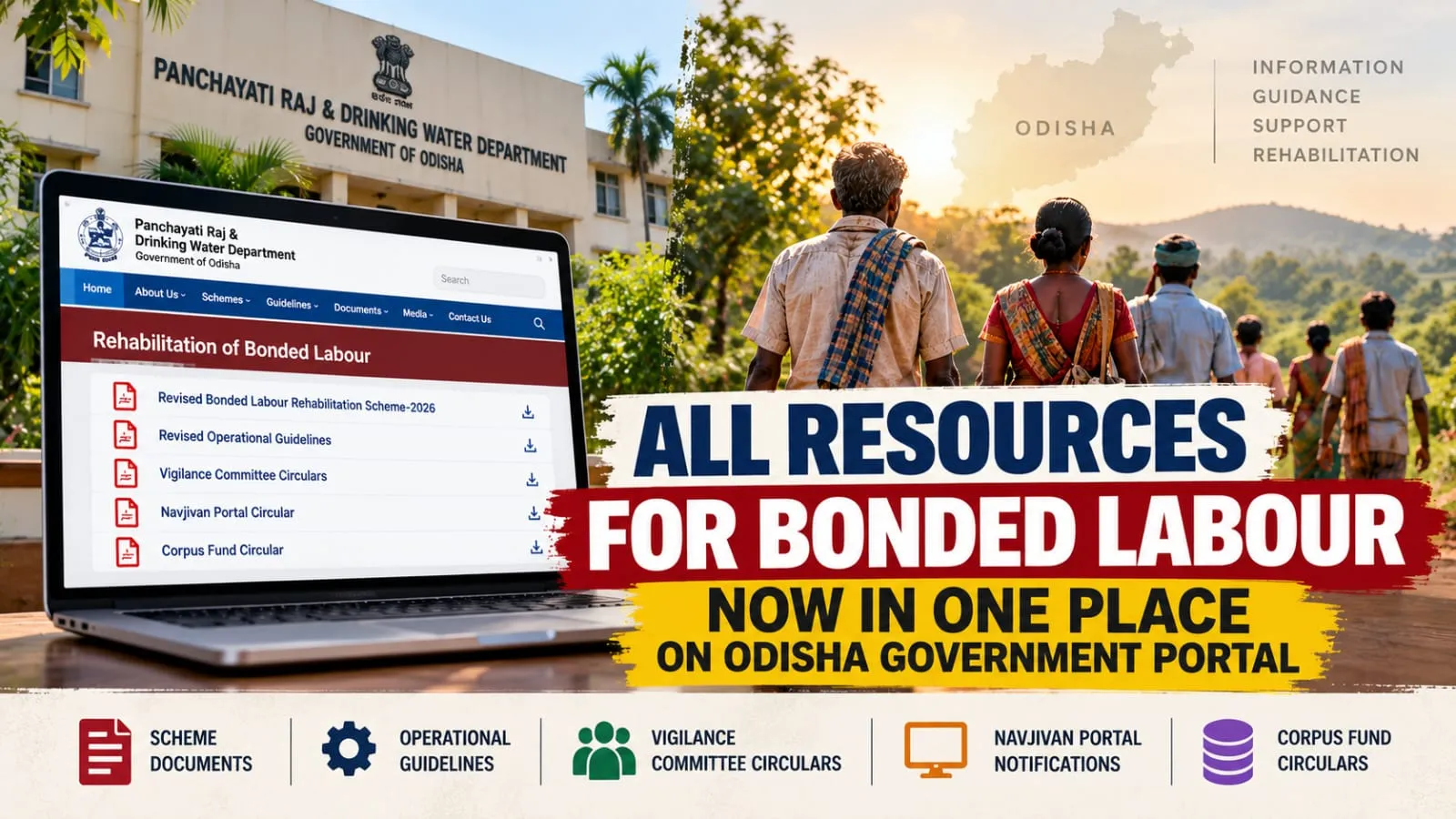
Bhubaneswar, October 30: In a significant step towards strengthening efforts to combat bonded labour and ensure the rehabilitation of survivors, the Odisha Government has launched a dedicated section on the Panchayati Raj and Drinking Water Department's official website, providing a centralized repository of information, government notifications, SOPs, schemes and operational guidelines related to bonded labour rehabilitation.
The newly created section, titled 'Rehabilitation of Bonded Labour', is available on the department's official portal (https://panchayat.odisha.gov.in/). It brings together key policy documents, circulars, schemes, standard operating procedures (SOPs) and other resources required by officials and stakeholders involved in the rehabilitation process.
Also Read: 42 officers transferred in major OAS reshuffle in Odisha
The newly created section currently hosts important documents, including the Revised Bonded Labour Rehabilitation Scheme-2026, revised operational guidelines, vigilance committee-related circulars, and notifications concerning the Navjivan Portal and Corpus Fund.
These resources will support government officials, Panchayati Raj Institutions (PRIs), civil society organizations, and other stakeholders engaged in the identification, release, rehabilitation, and reintegration of bonded labour survivors.
The establishment of this dedicated resource hub represents a positive step towards increasing visibility, transparency, and accessibility of information related to bonded labour rehabilitation. It also provides a sustainable platform for regular dissemination of policy updates and implementation guidance, strengthening efforts to combat bonded labour and support survivor rehabilitation across the state.
Meanwhile, the Ministry of Labour & Employment, in a landmark step toward ensuring comprehensive social security for India's massive informal workforce, has notified the official constitution of the National Social Security Board for Unorganised Workers and Gig & Platform Workers.
Established under the statutory framework of the Code on Social Security, these Boards mark a historic shift by integrating digital gig and platform professionals into India's formal welfare architecture.
The National Social Security Boards will meet at least thrice a year and will observe rules of procedure relating to the transaction of business at its meetings, as prescribed by the Central Government.
.webp)