

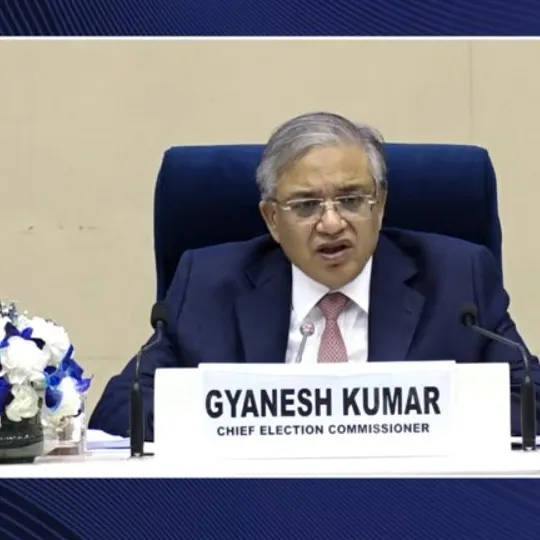
New Delhi, March 15: The Election Commission of India (ECI) on Sunday announced the schedule for the 2026 Legislative Assembly elections detailing a multi-phase polling roadmap for Assam, Tamil Nadu, West Bengal, Kerala, and the Union Territory of Puducherry beginning from April 9.
Addressing a press conference in New Delhi, Chief Election Commissioner Gyanesh Kumar on Sunday said voters in Assam, Kerala, and Puducherry will head to polling in a single-phase election.
On April 9 Assembly polls will be held in Assam, Kerala and Puducherry in a single Phase. It will be followed by Tamil Nadu where Assembly polls will be held in a single Phase on April 23. West Bengal will also hold the first phase of polling on the same day and the second phase on April 29. The results of all the elections will be held on May 4.
West Bengal will go to polls in two phases on April 23 and April 29 for the 294 constituencies in the state. In Phase-1, voting will be held in 152 seats while 142 seats will go for voting in the Phase 2.
Assam, Keralam and Puducherry to vote on April 9 in a single phase. The results will be declared on May 4.
The highly anticipated state assembly polls in Tamil Nadu will take place on April 23 and the results will be announced on May 4, announced the Election Commission
The term of the current Government in Tamil Nadu will end on May 10. Tamil Nadu's state assembly has 234 seats and the state has 2.77 crore voters.
Total Electors: 17.4 Crore
Total Assembly constituencies: 824
Total Polling Stations: 2.19 Lakh
Total Election Officials: 25 Lakh
Total Number of Electors in:
Assam - 2.50 crore
Kerala- 2.70 crore
Tamil Nadu - 5.67 crore
West Bengal- 6.44 crore
The CEC emphasised the importance of maintaining "pure electoral rolls" in elections, calling them the "bedrock of any democracy."
"My dear electors of Assam, Kerala, Puducherry, Tamil Nadu, and West Bengal, During the past few days, the Commission visited all the poll-bound states to review the preparedness for the ensuing Assembly elections. During these visits, the Commission met all the recognised political parties and received their suggestions. The Commission also met the District Electoral Officers, the SPs, the IGs, the DIGs, and the nodal officers of all the enforcement agencies. The Commission also held meetings with the Chief Electoral Officers, Chief Secretaries, and DGPs of the respective states and Union Territories," CEC added.