


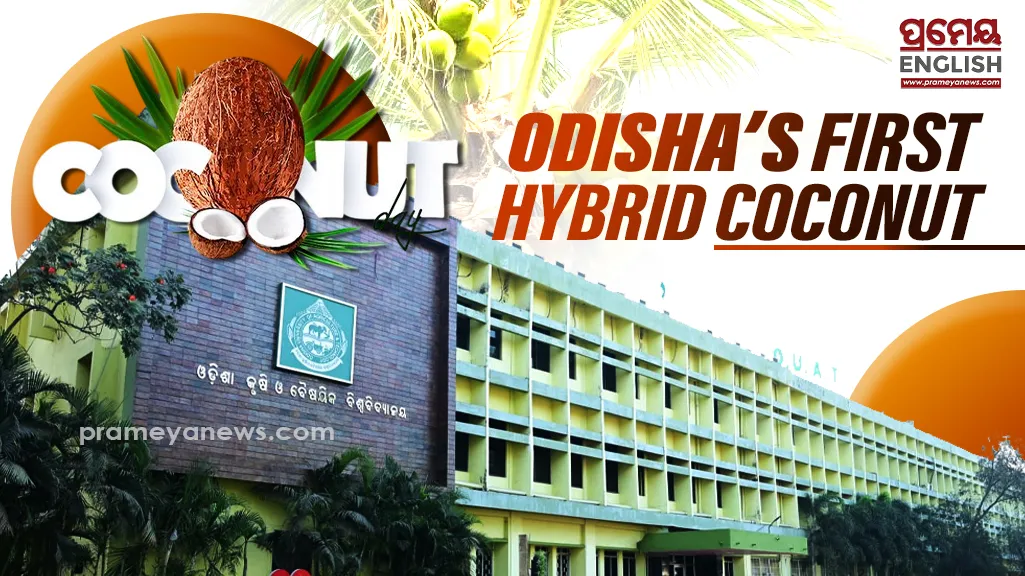
Bhubaneswar, Sept 2: On World Coconut Day, Odisha has a reason to look towards a new milestone in coconut cultivation. Researchers at the Odisha University of Agriculture and Technology (OUAT) have developed what is being described as the state’s first indigenous hybrid coconut variety, named ‘Konark’.
World Coconut Day is observed to promote coconut cultivation and highlight the economic importance of the crop worldwide. While several varieties, including hybrids developed in other states and countries, are cultivated in Odisha, the state did not have its own hybrid variety until now.
The OUAT has sent the newly developed ‘Konark’ variety to the government for approval. Once it receives official clearance, the hybrid coconut saplings are expected to be made available to farmers.
According to OUAT researcher Dr Ajit Kumar Sahu, the variety was developed by crossing the Sakhigopal variety with Gangabondam. The hybridisation work was carried out at the OUAT’s Konark Research Centre.
The variety was first planted at OUAT in Bhubaneswar in 2008. Nearly 18 years of research and evaluation went into developing the hybrid, which has now been named ‘Konark’.
What makes ‘Konark’ special?
The hybrid is expected to produce more than 150 coconuts annually under suitable conditions. It is also expected to perform well with relatively less water.
The coconuts are likely to have thick kernels with a sweet taste, while each tender coconut could yield around 500 ml of water. The variety is therefore expected to provide farmers with income from both mature coconuts and tender coconuts.
OUAT expands coconut research
Alongside the development of ‘Konark’, OUAT is also expanding its coconut research and planting programme.
Around 10 acres of land near Pattanayak Chhak in Sakhigopal is being developed for coconut cultivation. Nearly three acres have already been planted, while the remaining seven acres are expected to be taken up after the monsoon.
Around 30 varieties of both tall and dwarf coconut trees are being planted in the research plot. These include Gangabondam, MYD, MOD and MGD varieties, along with varieties from other countries.
Researchers plan to use these mother plants for future hybridisation programmes and develop new varieties suitable for Odisha. The initiative is also expected to help address the shortage of quality coconut planting material in the state.
OUAT estimates that after around 10 years, the 10-acre facility could produce 12,000 to 13,000 saplings annually.
Dwarf and tall varieties
Dwarf coconut varieties are expected to start producing fruit within four to five years, while good yields may take around 10 to 12 years. Such trees can produce around 80 to 100 fruits and may have a lifespan of 40 to 45 years.
Tall varieties generally begin bearing within around six years, with good production expected after 12 to 15 years. They can produce more than 100 fruits annually and may have a lifespan of 60 to 70 years.
With the proposed approval of ‘Konark’ and the expansion of coconut research, Odisha is now looking to strengthen its own coconut planting material and give farmers more locally developed options for profitable cultivation.