



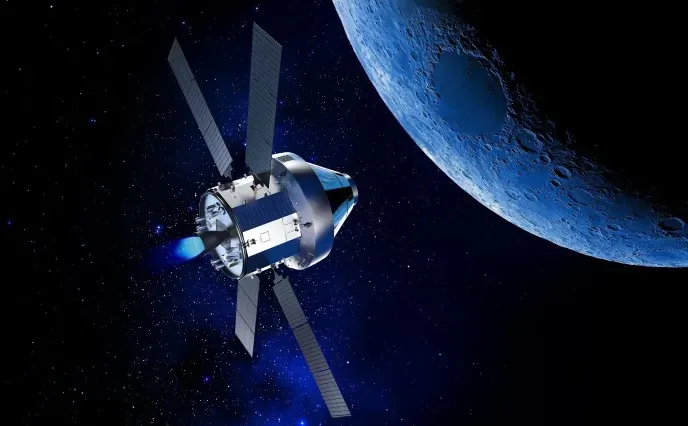
Four astronauts venture farther into deep space than humanity
NASA's Orion spacecraft successfully entered the Moon’s gravitational sphere of influence today, marking the first time humans have reached the lunar neighborhood in over half a century.This critical phase of the Artemis II mission sees the crew—Reid Wiseman, Victor Glover, Christina Koch, and Jeremy Hansen—preparing for a high-stakes slingshot maneuver around the lunar far side.
New Human Distance Record
Astronauts aboard the capsule are set to eclipse the legendary distance record established by the Apollo 13 mission in 1970.While the ill-fated 1970 voyage reached 248,655 miles from home, this modern quartet will push nearly 4,100 miles further into the void.This trajectory utilizes a "free-return" path, where lunar gravity acts as a natural tether to pull the vehicle back toward Earth without requiring a secondary engine ignition.
Observing the Lunar Far Side
Crews will experience a brief communication blackout as they pass behind the lunar disk.During these silent minutes, they will witness "Earthset" and "Earthrise," capturing high-resolution imagery of rugged craters and the Orientale basin—features rarely seen by human eyes.Scientific teams in Houston remain on standby to analyze real-time descriptions of the lunar terrain as the spacecraft skims just 4,000 miles above the surface.
This mission serves as a vital bridge for Odisha’s growing space-interest community, echoing the global shift toward establishing permanent lunar bases.Unlike the short-term visits of the last century, this flight tests life-support systems essential for multi-year Mars expeditions.Success here ensures that the upcoming Artemis III mission remains on track to land the first woman on the lunar south pole.