
.webp)


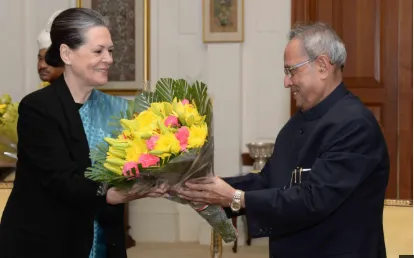
New Delhi, November 10: Congress Parliamentary Party chairperson Sonia Gandhi has recalled the late Pranab Mukherjee’s vast knowledge, political experience and unfulfilled ambition to become Prime Minister in her newly released memoir, Belonging: A Journey of Love.
In the book, Gandhi described Mukherjee, who served as India's 13th President, as an exceptionally knowledgeable politician with an encyclopaedic understanding of the Congress party's history, world affairs, philosophy and international developments.
“Pranab Mukherjee was celebrated for his encyclopaedic mind. Any question on the Congress Party's long history would find in him a ready answer,” she wrote, while also recalling his occasional short temper, saying he could become “almost purple in the face”.
Gandhi revealed that Mukherjee left the Congress in 1984 after Rajiv Gandhi was chosen as Prime Minister and subsequently formed his own political outfit. However, he returned to the Congress in 1989.
She further observed that Mukherjee never abandoned his ambition of becoming Prime Minister. Despite holding several key ministerial portfolios in successive Congress governments, he reportedly believed that his seniority and political experience made him a natural choice for the country's top executive post.
“Over the years he held virtually all the important portfolios in previous Congress governments, but deep down he felt his seniority and experience made him a natural candidate for the prime ministership,” Gandhi wrote.
Beyond her reflections on Mukherjee, Sonia Gandhi's memoir also presents a sharp critique of the BJP's political and ideological approach. She accused the ruling party of systematically weakening India's democratic institutions, suppressing dissent and concentrating political and economic power.
The memoir also raises concerns over the functioning of constitutional institutions, mainstream media, central investigative agencies and electoral processes, besides addressing welfare policies and the treatment of religious and political minorities.
Gandhi further alleged that the Rashtriya Swayamsevak Sangh (RSS) had brought most educational institutions under its ideological influence.
.webp)