
.webp)

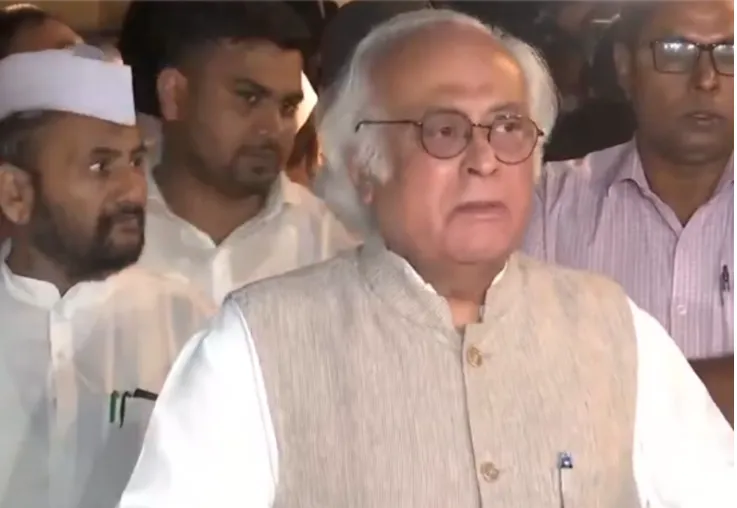
Ramesh said a two-hour meeting of all Pradesh Congress Committee (PCC) presidents and in-charges was held in the presence of Congress president Mallikarjun Kharge and Lok Sabha Leader of Opposition Rahul Gandhi to chalk out the party’s campaign and future programmes.
He said Opposition MPs have been asked to assemble at Makar Dwar at 10.30 am before beginning the march to the Election Commission at 11 am.
“Today, a meeting of all PCC presidents and in-charges was held for two hours. Congress President Mallikarjun Kharge and Lok Sabha LoP Rahul Gandhi were also present. Tomorrow at 11 am, MPs of all Opposition parties will march peacefully from Parliament House to the Election Commission. Everyone has been given the time of 10.30 am to assemble at Makar Dwar. This march will be carried out in a peaceful manner,” Ramesh said.
He added that INDIA bloc parties would organise district-level padyatras, demonstrations and meetings until October 8 as part of the campaign.
Ramesh also outlined a series of programmes planned at the block, state and district levels. He said the campaign would focus on the Opposition's allegations of irregularities in electoral rolls and the demand for the removal of the Chief Election Commissioner.
“From October 10 to October 20, there will be meetings at the block level. From October 25 to November 25, ‘Save votes, save the country’ rallies will be organised at the state and district levels, along with chaupals in every village,” he said.
According to Ramesh, the campaign will also seek information about voters whose names are allegedly missing from electoral rolls. He claimed that the Opposition would collect details concerning around 13.5 crore voters whose names, according to the parties, are not included in the voter lists.
Meanwhile, the Supreme Court on Monday clarified that it had not approved any modified version of Form 6, which is used for the enrolment of new voters during the Special Intensive Revision (SIR) exercise.
Chief Justice of India Surya Kant said the court had not approved any modified Form 6 and indicated that it would examine the matter after the relevant records were produced before it.
“Any modified Form 6 has not been approved by us. Let’s be clear. When the record is produced, we would like to see who has modified it,” the CJI said.
The Supreme Court also declined to pass an ex-parte interim order seeking the suspension of Chief Election Commissioner Gyanesh Kumar and issued notices to the Centre, the Election Commission of India, Kumar and other officials.
The petition before the court alleges that 14 key decisions related to the SIR exercise were taken in the name of the Election Commission despite objections allegedly recorded by the other two Election Commissioners, Sukhbir Singh Sandhu and Vivek Joshi.
The plea has also raised questions over the alleged alteration of Form 6 and changes to electoral-roll systems without the participation or approval of the other Election Commissioners.
The court said it would first examine the allegations after receiving responses from the respondents. CJI Kant further observed that if any violation of the statutory framework was established, the court could undo the decision.
.webp)