
.webp)

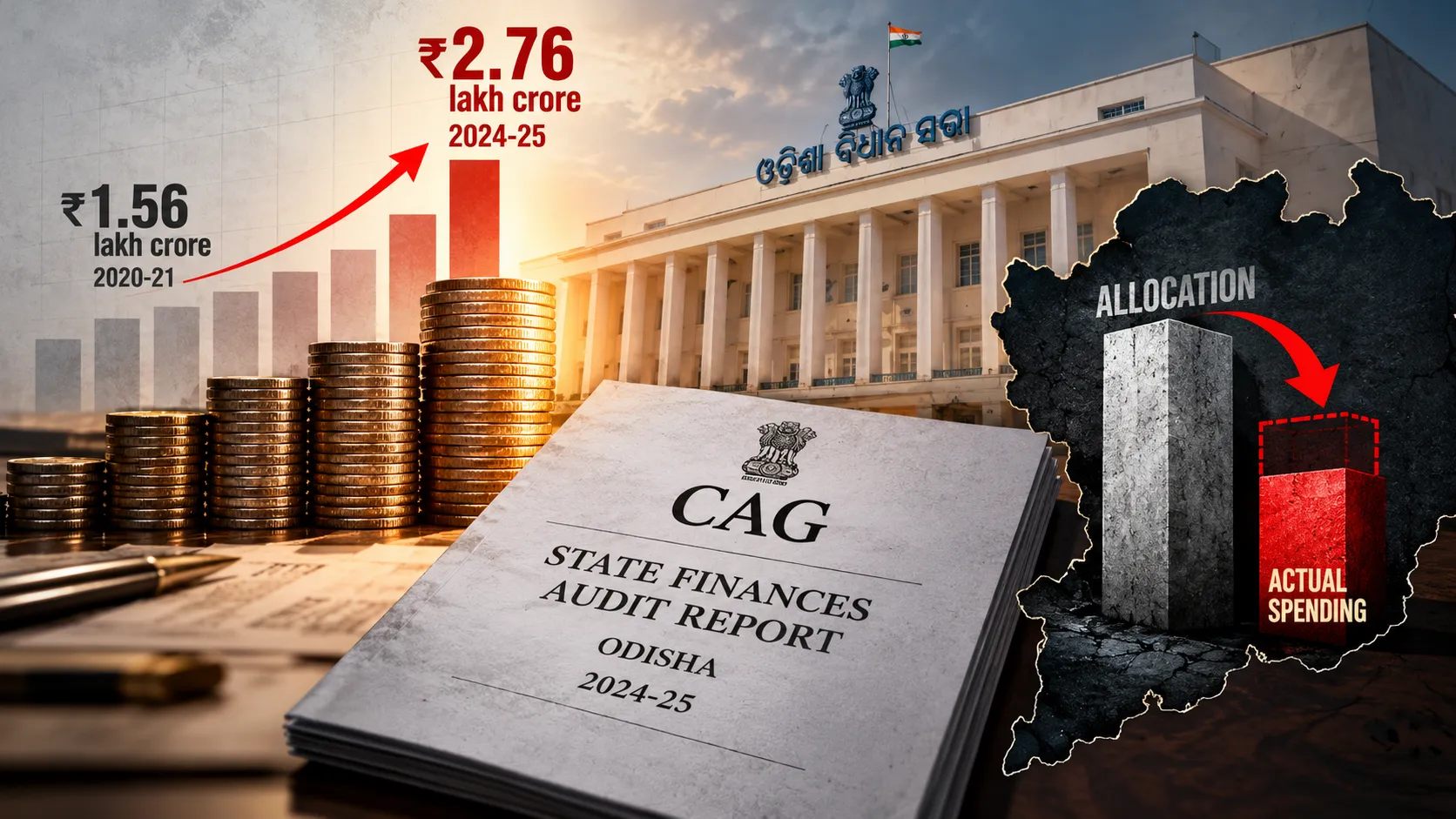
Bhubaneswar, Oct 25:Odisha’s original budget estimate increased by nearly 77% between 2020–21 and 2024–25, rising from ₹1.56 lakh crore to ₹2.76 lakh crore. Yet actual expenditure fell short of the original allocation in each of the five years, with the Comptroller and Auditor General (CAG) flagging persistent gaps in budget planning, expenditure estimation and fund utilisation. The findings raise questions about the state’s ability to translate expanding budgetary commitments into timely implementation of public programmes.
The CAG’s State Finances Audit Report for 2024–25 found that savings against the total budget remained between 17.70% and 25.98% during the five-year period, pointing to shortcomings in assessing financial requirements and utilising allocated funds.
Odisha’s actual expenditure rose from ₹1.24 lakh crore in 2020–21 to ₹2.32 lakh crore in 2024–25, but spending consistently fell short of original budget estimates. The gap widened from around ₹32,000 crore in 2023–24 to ₹44,000 crore in 2024–25, highlighting the persistent mismatch between budgetary allocations and actual expenditure.

Also read: PM Modi inaugurates RBI Data Centre and Cybersecurity Training Institute in Odisha’s Jatani
Despite expenditure falling short of original estimates annually, supplementary provisions were made in each year. These stood at ₹11,700 crore in 2020–21, ₹19,833.13 crore in 2021–22, ₹16,800 crore in 2022–23, ₹28,200 crore in 2023–24 and ₹12,155.74 crore in 2024–25.
The CAG noted that supplementary grants are intended to meet additional requirements. However, in 33 instances during 2024–25, supplementary provisions totalling ₹9,090.78 crore were made even though expenditure remained below the original allocations in those cases.
The audit also identified 15 schemes across nine government grants with revised outlays totalling ₹460.07 crore but zero expenditure during 2024–25. The government did not provide specific reasons for the non-utilisation. The schemes covered areas including technical education, school transformation, handicrafts, MSME market access and public services.
Delays in approving scheme guidelines, absence of administrative sanctions, non-release of funds and non-receipt of central assistance were among the factors associated with low expenditure across schemes. The CAG cautioned that non-implementation could deprive intended beneficiaries of programme benefits and prevent other departments from using available resources.
The report highlighted estimation and implementation problems in major welfare schemes. Under the Pradhan Mantri Janjati Adivasi Nyaya Maha Abhiyan (PM-JANMAN), expenditure stood at ₹306.03 crore against a ₹600-crore provision, leaving ₹293.97 crore unspent. The CAG attributed the shortfall partly to an erroneous departmental proposal that inflated the budget requirement.
Under Pradhan Mantri Awas Yojana-Gramin (PMAY-G), the adjusted provision was ₹5,390 crore after reappropriation. Against this, ₹1,001.88 crore was booked as expenditure through a transfer to the scheme’s Single Nodal Agency account, leaving savings of ₹4,388.12 crore. The state completed 22,026 houses under the scheme during the year.
The findings come as Odisha seeks to accelerate development spending. At a Finance Department review in August 2026, Chief Minister Mohan Charan Majhi was informed that capital expenditure through July reached ₹11,300 crore, up 20.2% from ₹9,399 crore in the corresponding period a year earlier. Programme expenditure also rose 19.1% year-on-year. The Chief Minister called for faster capital and programme spending to support infrastructure and long-term growth.
The CAG’s findings point to a recurring challenge in Odisha’s public finances: expanding budgetary allocations do not necessarily translate into proportionate expenditure or timely delivery of public services. With supplementary provisions continuing despite repeated savings, the key test for the state is whether improved financial planning and closer monitoring can align allocations with actual requirements and implementation capacity. The extent to which the 15 schemes that recorded zero expenditure in 2024–25 have since progressed will be an important measure of whether the state is converting budget commitments into tangible outcomes for beneficiaries.
.webp)