
.webp)


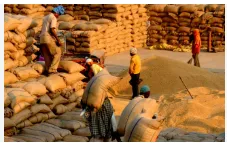
Bhubaneswar, November 9: The Odisha Cabinet, chaired by Chief Minister Mohan Charan Majhi, on Monday approved 13 proposals, including the Food and Paddy Procurement Policy for the Kharif Marketing Season (KMS) 2026-27, targeting the procurement of around 78 lakh metric tonnes (LMT) of paddy from farmers.
Under the policy, the government has set a target of procuring 53 LMT of rice, equivalent to approximately 78 LMT of paddy. Farmers will receive a total of ₹3,100 per quintal, comprising the Minimum Support Price (MSP) and input assistance, as per the government’s decision.
The farmer-centric policy aims to ensure transparent procurement at MSP, timely payments, efficient milling and uninterrupted rice supplies under the Public Distribution System (PDS) and various welfare schemes.
To strengthen transparency, the government will integrate the Paddy Procurement Automation System (P-PAS), Aadhaar e-KYC, Bhulekh land records and the National Payments Corporation of India (NPCI) platform. The system will also include 100 per cent field verification of registered farmers and satellite imagery-based validation of paddy cultivation areas, supported by Digital Crop Survey (DCS) data.
The policy also extends registration and procurement facilities to eligible sharecroppers (Bhaga Chasis) through digital consent and biometric or mobile-based authentication of landowners.
MSP payments will be directly credited to farmers' Aadhaar-linked bank accounts through NPCI within 24 to 48 hours of paddy procurement.
Procurement centres (PPCs), operated through PACS, LAMPCS and Pani Panchayats, will facilitate local procurement. Farmers will receive advance SMS alerts in Odia regarding procurement dates and quantities.
To maintain quality and accountability, FAQ testing, AI-based grain analysers at procurement centres handling more than 5,000 MT, CCTV surveillance and live monitoring will be introduced. Mill tagging and route optimisation will further improve logistics, ensure timely milling and reduce transportation costs.
The government has also planned district-level control rooms and a toll-free helpline (1967) to address farmers' grievances. Border checkpoints and CCTV surveillance will be strengthened to prevent the unauthorised movement of paddy into Odisha.
The Kharif procurement season will run from November 1, 2026, to March 31, 2027.
The policy is intended to ensure that every eligible farmer gets a fair opportunity to sell marketable surplus paddy at the assured MSP and receives payment without delay.
Odisha will also continue to meet its rice requirements under the National Food Security Act (NFSA), State Food Security Scheme (SFSS) and other welfare programmes, while surplus rice will be supplied to the Food Corporation of India (FCI) for the Central Pool.
.webp)