

.webp)


US economists win 2026 Nobel for macroeconomic stabilisation models
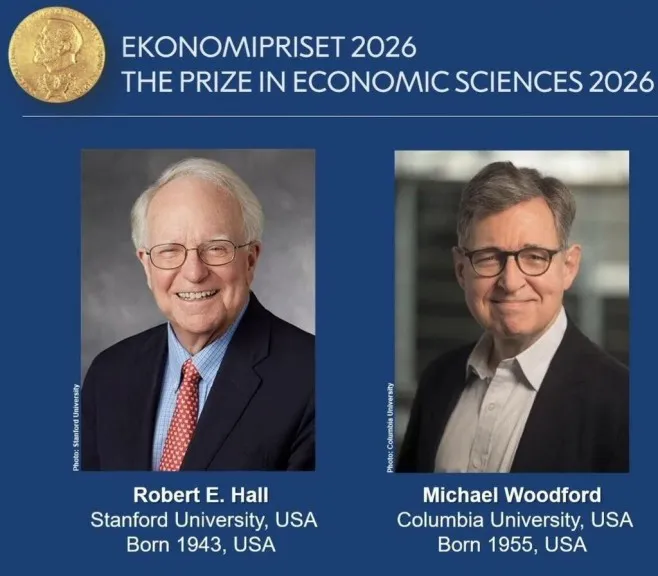
Stanford University’s Robert E. Hall and Columbia University’s Michael Woodford won the 2026 Nobel memorial prize in economics on Monday. Both American-born economists earned this prestigious recognition for their deep research into the microeconomic foundations of macroeconomic stabilisation. Officials from the Royal Swedish Academy of Sciences announced the winners in Stockholm, concluding this year's cycle of Nobel honors.
📲Follow our WhatsApp Channel for the latest news, breaking updates, and important headlines. Stay connected with us for more updates!
Praising stable theoretical foundations
John Hassler, chair of the Committee for the Prize in Economic Sciences, highlighted the true importance of their collaborative research. He explained that their work gives central banks and governments worldwide highly stable theoretical frameworks. These robust models allow financial authorities to properly manage sudden economic shocks, such as unexpected energy crises or rapid shifts in household consumption patterns. Their insights essentially provide policy-makers with better tools to navigate volatile global markets. Modern fiscal policies rely heavily on these specific mathematical principles to keep inflation in check and maintain optimal employment rates during unpredictable times.
Honouring Alfred Nobel's legacy
Formally titled the Bank of Sweden Prize in Economic Sciences in Memory of Alfred Nobel, this award traces its exact origins back to 1968. Swedish central bankers established the endowment specifically to honor the famous 19th-century inventor of dynamite. Winners of this specific prize receive 12 million Swedish kronor, which currently translates to roughly $1.2 million. Laureates formally collect their awards during a ceremony held every December 10, marking the anniversary of Alfred Nobel's passing in 1896. Last year, the committee recognized researchers who explored how business innovation drives human welfare forward, even when older companies fail. This year's focus shifts directly back to structural stability, proving that understanding consumer behavior remains essential for long-term financial health.
Image Courtesy: Ynet News
.webp)