
.webp)


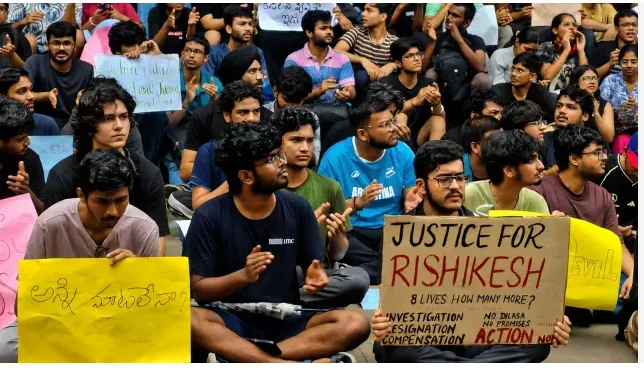
Speaking to ANI, Saksham, a second-year BTech student participating in the ongoing protest, said the agitation began after Kumar’s death on August 22. He said students’ key demands, including an independent inquiry, financial assistance for Kumar’s family and a systemic overhaul of the institute’s support mechanisms, remain unaddressed.
“Our core demands have largely not been accepted. Demands were raised regarding financial compensation, an independent investigation, and a free and fair systemic overhaul. On all these fronts, students feel that no concrete decisions have been made yet, which is why they are continuing with their protest,” Saksham said.
Rishikesh Kumar died on August 22 after falling from the sixth floor of the Lecture Hall Complex (LHC) at IIT Delhi. Police have said that no suicide note was recovered and that the circumstances surrounding his death are being investigated.
Saksham said he had met Kumar twice through the institute’s Purvanchal Community and remembered him as a helpful student with strong leadership qualities.
“He was just like any normal person, and in fact, he possessed good leadership qualities and a strong personality. So it never crossed our minds that he would take such a drastic step,” he said.
According to Saksham, students are seeking systemic reforms rather than simply calling for the removal or resignation of individual administrators.
“The reality is that every time an incident occurs, the administration simply claims that an investigation will be conducted and a committee will be set up. Every time, the same cycle repeats: a committee is formed, a report is submitted, everything goes on paper, but nothing concrete changes on the ground,” he said.
Saksham said students routinely face pressure related to academics, placements, internships and projects, and that their concerns must be addressed before they reach a crisis point.
“Students face immense pressure—mental stress, academic burden, placement pressure, internships, projects, and various other demands. When a student feels overwhelmed, the administration doesn’t listen, and if their social support circle is weak, they feel pushed into a corner,” he said.
One of the students’ key demands is the establishment of an independent and dedicated Mental Health Cell at IIT Delhi.
“One concrete demand we are making is the creation of an independent, dedicated Mental Health Cell. This should be a separate body where any student facing mental health struggles can reach out and receive support, ensuring no one’s grievances go unheard,” Saksham said.
He also questioned whether administrative resignations alone would prevent similar incidents in the future, arguing that changing individuals would not address what students view as deeper systemic shortcomings.
“If another suicide happens under the newly appointed Dean, what will we do? We will protest again. That raises a fundamental question: are we going to wait for another tragedy before demanding real systemic reform?” he said.
Saksham said the protest would continue until students were offered meaningful solutions.
“The goal of the protest is to achieve systemic solutions. As long as meaningful solutions are not offered, opposition will continue,” he said.
He also alleged that some political elements were attempting to divert the movement from its focus on student welfare and mental health, maintaining that students wanted the matter to remain centred on IIT Delhi and its institutional support systems.
Meanwhile, former Uttarakhand DGP Ashok Kumar, who had been proposed as chairperson of the external inquiry committee constituted by IIT Delhi to probe Rishikesh Kumar’s death, has recused himself from the panel, citing prior commitments, sources at IIT Delhi confirmed to ANI.
A new chairperson is expected to be announced soon.
The proposed five-member External Inquiry Committee, announced by IIT Delhi Director Prof Rangan Banerjee, included Ashok Kumar, AIIMS New Delhi psychiatry department head Prof Pratap Sharma, two student representatives and the institute’s Registrar, who was designated secretary and convenor.
Some protesting students had objected to the composition of the panel and demanded that it be headed by a former High Court judge.
IIT Delhi has said the external committee will examine the circumstances surrounding the incident and recommend further measures to strengthen student support systems. The institute has also proposed appointing an external ombudsperson to address student grievances that remain unresolved through existing internal mechanisms.
According to IIT Delhi, Rishikesh Kumar joined the institute in July 2025 and was residing in a hostel on campus.
The institute said that after concerns were raised by fellow students following the Holi festivities earlier this year, Kumar was referred to the institute hospital and subsequently underwent around a month of treatment at a specialised hospital.
IIT Delhi said his requests to withdraw from the second and third semesters were approved and that he received counselling and treatment support during July and August.
Students have continued protesting on the IIT Delhi campus since Kumar’s death, demanding an independent probe, the resignation of the Dean of Student Welfare, financial assistance for Kumar’s family and broader reforms to the institute’s student welfare and mental health support mechanisms.
.webp)