


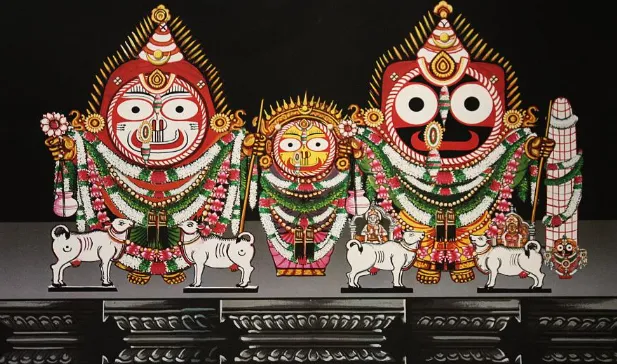
Puri, Sept 6: The holy Banabhoji Besha of Lord Jagannath and Lord Balabhadra will be observed at the Srimandir today as per the age-old tradition on Bhadrapada Krishna Dashami.
During this special attire, the two deities are adorned in the form of cowherd boys, carrying a stick in one hand and a sling containing butter in the other, symbolising the playful pastoral life associated with their childhood.
The tradition is believed to have been in practice since the time of Gajapati Prataprudra Dev, associated with the period of Sri Chaitanya and Raya Ramananda.
Following the Madhyanna Dhupa, two Agyanamalas of Lord Balabhadra and Lord Jagannath are taken to the Dakshina Ghara. The Agyanamalas are subsequently offered to Rama and Krishna. After receiving them, the deities are placed on a palanquin near Batadwara.
The palanquin is then taken in a ceremonial procession by the Biman Badu servitors, accompanied by traditional musical instruments, including bells, umbrellas and kahali, to the wooden throne arranged in front of Bada Chhata Matha near the Lion’s Gate.
At the spot, the traditional Kolibika Niti is performed. Following its completion, the Pushpalak servitors adorn the deities in the elaborate Banabhoji Besha.
The special attire features several gold ornaments along with decorative elements made of sola, cane, cloth and zari. Golden kia ornaments are placed on the headgear of the deities.
As part of the unique decoration, wooden cows and calves are placed on both sides of the deities on the Ratna Singhasana, reflecting the pastoral setting of the Banabhoji tradition.
In the Banabhoji Besha, Lord Balabhadra and Lord Jagannath hold a long sling made of cloth and zari, with a silver bowl containing sara (cream/butter) suspended at its lower end.
They also hold a stick in their other hands.
The sara is traditionally supplied by the Mahabhoi (Gouda) servitors of Srimandir.
Another distinctive tradition associated with the Besha is the garland made of specially prepared Khua Peda, which is supplied from the house of Pat Joshi Mahapatra.
The Banabhoji Besha offers devotees a glimpse of the divine childhood and pastoral traditions associated with Lord Jagannath and Balabhadra, making it one of the distinctive ritual adornments observed at the Srimandir.
According to Puranic traditions and popular belief, the Banabhoji Besha at Srimandir is associated with the childhood pastimes of Lord Krishna and Lord Balarama, particularly their journey into the forest with cows and calves for a picnic.
The special Besha symbolically portrays the deities setting out for a forest outing, reflecting the pastoral life and childhood leelas of Krishna and Balarama.
The day also holds significance in the traditional Sahi Jatra customs of Puri. As part of the age-old practice, Bakasura from the Balishahi Jaga Akhada comes out in a procession and moves through the city before visiting Srimandir. Traditional rituals associated with the Bakasura Badh and Arghasura Badh are subsequently performed.
Golden Ornaments Used in Banabhoji Besha:
A number of traditional golden ornaments and decorative accessories are used to adorn the deities during Banabhoji Besha. These include: