

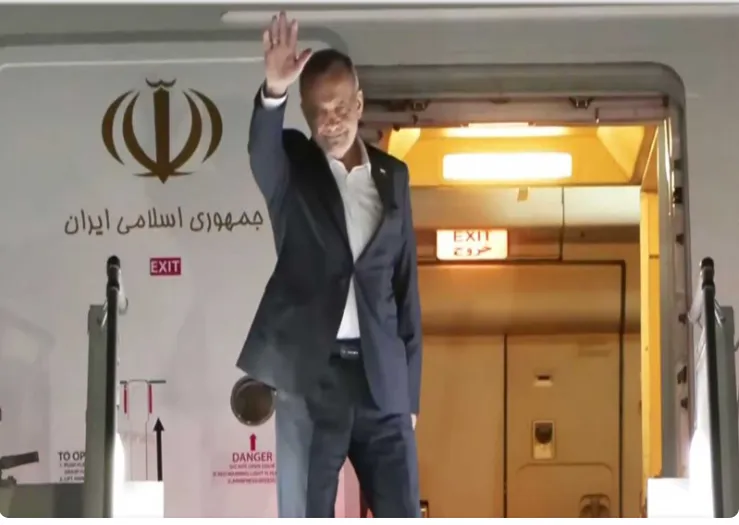
Pezeshkian made the remarks after meeting Abu Dhabi Crown Prince Sheikh Khaled bin Mohamed bin Zayed Al Nahyan on the sidelines of the BRICS Summit in New Delhi, in a significant diplomatic engagement between Iran and the United Arab Emirates amid continuing tensions in West Asia.
In a series of posts on X, the Embassy of Iran in India quoted Pezeshkian as saying, “We had a good conversation with the Crown Prince of Abu Dhabi, and agreed to put the past behind us and look to the future.”
He added that he also held discussions with the Presidents of Russia and China, describing them as mostly brief exchanges, while expressing optimism over the prospects for stronger economic cooperation.
During his India visit, Pezeshkian also met Prime Minister Narendra Modi ahead of the BRICS Summit. The two leaders discussed India-Iran bilateral relations and exchanged views on the latest developments in West Asia, including growing uncertainty and disruptions affecting the strategically important Strait of Hormuz.
According to the Ministry of External Affairs, Modi reiterated India’s consistent position that all outstanding issues must be resolved through dialogue and diplomacy.
“Prime Minister reiterated India’s consistent position that all issues must be resolved through dialogue and diplomacy. He also underscored the need for continued efforts to ensure lasting peace and stability in the region, safeguarding freedom of navigation and commerce, and the safety and well-being of seafarers,” the MEA said in a statement.
The meeting was the second between Modi and Pezeshkian in recent times. The two leaders had earlier met on the sidelines of the Shanghai Cooperation Organisation Summit in Bishkek on August 31.
During Friday’s meeting, Modi thanked Iran for its regular and high-level participation in BRICS-related meetings despite the challenging circumstances. He also highlighted the potential of BRICS to promote resilience, innovation, cooperation and sustainability among countries of the Global South.
President Droupadi Murmu also met Pezeshkian at Rashtrapati Bhavan on Saturday during his visit to New Delhi.
Pezeshkian held several other meetings with BRICS leaders and officials during his stay in India. The Iranian Embassy said he met South African President Cyril Ramaphosa on the sidelines of the summit and discussed issues of mutual interest.
Iranian Foreign Minister Seyed Abbas Araghchi separately met Egyptian Foreign Minister Badr Abdelatty, with the two sides exchanging views on bilateral relations and regional developments. Araghchi also held talks with Cuban Foreign Minister Bruno Rodríguez Parrilla on the sidelines of the BRICS Summit.
Addressing the BRICS Summit, Pezeshkian called on the grouping to take practical measures against what he described as unilateral and “inhumane” sanctions, arguing that BRICS must serve as a voice for justice.
“BRICS members have a responsibility to stand against the normalisation of attacks on civilian infrastructure and peaceful nuclear facilities, because any action against these sites constitutes a direct threat to international peace and security,” he said.
Pezeshkian also called for a more active BRICS role on the Palestine issue, saying the Palestinian people’s right to self-determination was a serious test of the credibility and legitimacy of global governance.
The BRICS leaders unanimously adopted the New Delhi Declaration 2026, which called for reforms in global governance and stronger representation for developing countries.
The declaration also expressed deep concern over the continued escalation of tensions in West Asia and called for maximum restraint and avoidance of actions that could further worsen the situation.
It called for the protection of civilians and civilian infrastructure, respect for sovereignty and territorial integrity, and greater efforts through dialogue and diplomacy to achieve lasting peace, security and stability in the region.
The declaration further stressed the importance of maintaining the smooth flow of global trade, supply chains and energy in accordance with international law.
Prime Minister Modi described the outcome of the summit as reflecting a BRICS that is “wider in reach and stronger in purpose.”