
.webp)



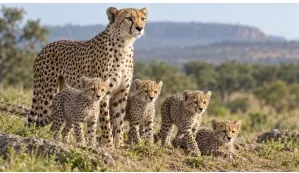
New Delhi, November 26: India’s cheetah population has increased to 62 following the birth of nine cubs in two successive litters at Madhya Pradesh’s Kuno National Park, marking a significant milestone in the country’s cheetah reintroduction and conservation programme.
 According to a government statement, the two litters were born on October 5 and November 20, taking the number of cheetah cubs born in India to 43. India-born cheetahs now account for nearly 70 per cent of the country’s total cheetah population.
The first litter was born on October 5, when KJP21, a 32-month-old female cheetah born in India, delivered five healthy cubs. She became the third India-born female cheetah to reproduce, after Mukhi and KGP12. The father of the cubs is a male cheetah translocated from Botswana, marking the introduction of the Botswana genetic lineage into the India-born cheetah population.
The government described the development as an important achievement under the National Action Plan for Cheetah Introduction in India. The plan identifies successful breeding by the first India-born generation, known as the F1 generation, as a key milestone for the successful establishment of cheetahs at reintroduced sites.
Another significant development followed on November 20, when KOMG 3, a 30-month-old female cheetah brought from Botswana, gave birth to four healthy cubs.
She became the first female cheetah translocated from Botswana to give birth in India. Notably, she gave birth to the cubs under free-ranging conditions after spending more than four months in the wild.
The birth also marked the second recorded instance of a cheetah giving birth in the wild outside Closed Natural Areas (CNAs) since the reintroduction programme began in 2022. CNAs are large, protected and fenced acclimatisation areas within designated release sites.
The government statement said successful reproduction under free-ranging conditions is another important criterion identified in the National Action Plan for evaluating progress towards the programme’s long-term objectives.
It also highlighted the development's significance for global cheetah metapopulation initiatives, noting that India provides additional space for breeding cheetahs from the African continent, whose populations remain fragmented across their natural habitats.
With the arrival of the nine cubs in the two litters, India's total cheetah population has reached 62, including 43 cubs born in the country.
The government said the growing share of India-born cheetahs reflects the increasing contribution of domestic breeding to the programme's population base. While the latest births represent an encouraging step in conservation efforts, the survival and future reproduction of the cubs will remain crucial indicators of the programme's long-term success.
.webp)