
.webp)


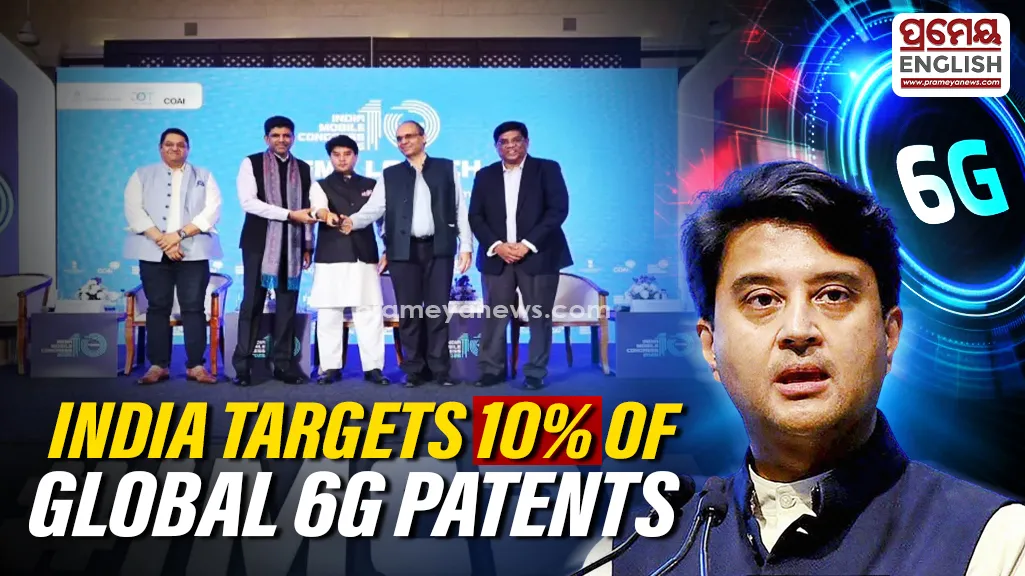
New Delhi, Oct 11: India aims to secure a 10 per cent share of global 6G patents as it looks to move beyond adopting telecommunications technologies towards developing indigenous solutions and shaping international standards, Communications Minister Jyotiraditya M Scindia has said.
The ambition featured prominently at the 10th edition of India Mobile Congress (IMC) 2026, which concluded on Saturday after four days of discussions on next-generation connectivity, artificial intelligence (AI) and digital innovation.
Held under the theme ‘Scale Without Boundaries’, the event brought together policymakers, industry leaders and technology developers to explore emerging technologies and their potential to drive inclusive digital growth. India is seeking to strengthen its position in the global telecommunications ecosystem through domestic innovation and greater participation in international standard-setting.
The concluding day focused on applying AI to agriculture, developing autonomous AI agents for 5G networks and expanding broadband connectivity in rural areas. The Global Initiative on AI for Agri-Food Systems Meeting, organised in collaboration with the International Telecommunication Union (ITU), examined how AI could address challenges across agricultural and food systems. The event also featured the Robotics for Good Youth Challenge India and the ITU Build-A-Thon, where engineers worked on autonomous AI agents for 5G network orchestration.
Discussions also explored sustainable financing models for rural broadband deployment and the infrastructure needed to ensure that high-speed connectivity translates into economic opportunities for rural communities.
Dr Bilel Jamoussi, Deputy Director of the ITU's Telecommunication Standardization Bureau, said agricultural AI should prioritise solving farmers' real-world problems rather than focusing solely on technological sophistication. He stressed the importance of developing solutions alongside farmers and establishing international standards to help successful applications scale beyond pilot projects.
Syed Tausif Abbas, Senior Deputy Director General and Head of the Telecommunication Engineering Centre under the Department of Telecommunications, said agricultural AI should be evaluated through improvements in farmers' livelihoods, productivity, supply-chain efficiency and food security.
He also emphasised the need for transparent, inclusive and accessible solutions that address data quality, privacy and the requirements of small and marginal farmers. Industry representatives highlighted the importance of common standards for data sharing and interoperability across agricultural technology platforms. Debasish Mahalik of the Bureau of Indian Standards said robust frameworks covering data quality, privacy, security and interoperability would be essential to scaling digital agriculture sustainably.
The discussions also underscored the need for AI evaluation frameworks that assess fairness, transparency, robustness and safety, particularly when systems operate under adverse conditions. India Mobile Congress CEO Ramakrishna P said the 10th edition reflected the country's ambition to move beyond technology deployment towards developing indigenous solutions and contributing to global standards.
The event echoed Prime Minister Narendra Modi's emphasis on indigenous intellectual property and sovereign semiconductors, reinforcing India's push to become a technology developer and global standard-setter. (With ANI inputs)
.webp)