
.webp)


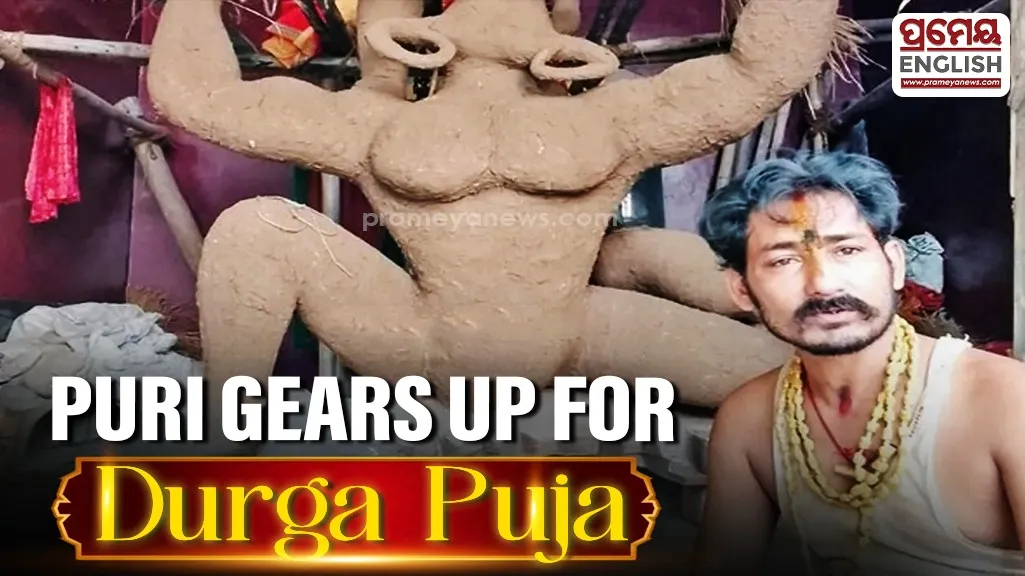
Puri, Oct 11: As the festive spirit of Sharadiya Puja fills Matimandap Sahi in Puri, artisans breathe life into Goddess Bhogabati, a revered deity believed to protect children and bless devotees with good health.
The narrow lanes of Matimandap Sahi, situated to the southeast of the Shree Jagannath Temple in Puri, are abuzz with religious fervour and festive preparations. As the neighbourhood gears up for Sharadiya Puja, artisans are immersed in crafting the clay idol of Goddess Bhogabati at the Bhoga Jaga Mandap, where centuries-old traditions and deep-rooted faith come together.
Popularly known as Bhoga Jaga Thakurani, Goddess Bhogabati is worshipped as a deity who delights in offerings of food. Beside her shrine resides Lord Shri Shri Kameswar Mahadev. For generations, devotees have regarded the goddess as a protective guardian of children, with local folklore recounting stories of children being saved from life-threatening situations through her divine grace.
The goddess is also associated with the well-being of children who play within the temple premises. Devotees believe that remembering the mother goddess and partaking of the bhoga offered to her can bring relief from even chronic ailments. These enduring beliefs continue to strengthen the bond between the deity and the people of Matimandap Sahi.
Crafting divinity, one layer at a time
The responsibility of shaping the clay idol rests with brothers Chittaranjan Maharana and Manoranjan Maharana, traditional painters and servitors associated with the Shree Jagannath Temple. Their work reflects a blend of artistic skill, ritual discipline and inherited craftsmanship.
The process begins on Radhashtami, when the first peg is driven into the idol's framework. Over the next three days, the artisans build the basic structure using straw. A layer of agadi mati—a special clay mixture prepared using residue obtained from paddy and puffed rice—is then applied to give the figure its form. This is followed by a coating of sand-mixed clay, after which cloth is applied to the surface to refine the structure.
According to Chittaranjan Maharana, the idol is set to receive its cloth covering as the final stages of preparation progress. With each successive layer, the goddess gradually emerges from the raw materials, taking shape before the stone idol that is worshipped throughout the year.
An eight-armed goddess with a unique gaze
Goddess Bhogabati is depicted in the form of Goddess Harchandi, an eight-armed manifestation of the Divine Mother. The idol portrays her twisting the face of Mahishasura, the buffalo demon, as she strikes him with her trident.
At first glance, visitors often assume that the goddess is looking directly at Mahishasura. But the artisans offer a distinctive interpretation: her gaze is fixed not on the demon, but on the offerings placed before her.
“The mother goddess keeps her eyes on the bhoga,” Chittaranjan Maharana explains, highlighting the unique feature that gives the deity her identity as Bhoga Jaga Thakurani.
The newly crafted clay idol is modelled closely on the existing stone image, preserving its traditional appearance and distinctive features. While the stone deity receives daily offerings of sheetala bhoga and sankhudi bhoga, the temporary clay manifestation becomes the focal point of the annual Sharadiya Puja celebrations.
Three days of rituals and devotion
The goddess is worshipped over a three-day period, during which traditional rituals and offerings form the heart of the celebrations. Alongside sankhudi bhoga, offerings that include roasted fish are made as part of the observances described by the local tradition.
Amid the devotional gatherings, the goddess also participates in the Ekadashi Deva Sabha, where she is taken in a ceremonial procession in the presence of devotees. The festivities eventually conclude with the ritual offering of a pumpkin as a symbolic sacrifice, followed by the immersion of the clay idol.
For the residents of Matimandap Sahi, the occasion is much more than an annual religious event. It is a celebration of community, inherited artistry and unwavering faith in a mother goddess believed to watch over children, answer prayers and accept the devotion expressed through every offering.
As the artisans complete their work and the neighbourhood prepares for the rituals ahead, Bhoga Jaga Thakurani once again takes centre stage—her clay form embodying a living tradition that continues to connect Puri's cultural heritage with the faith of its people.
.webp)