


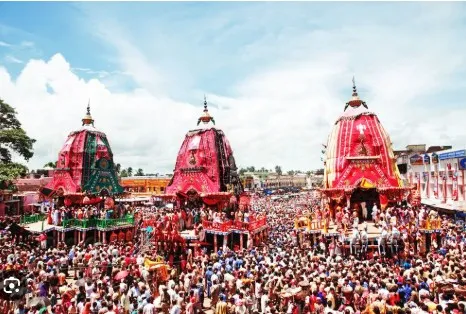
Puri, July 1: Lord Jagannath's Rath Yatra, widely famous as the Car Festival in Odisha’s holy city Puri has been a center stage among all festivities of eastern India, even of the world. Beginning with a mere spiritual event relating to the ancient Shree Jagannath Temple sculpted in 11th century, the festivity has now emerged as one of the great wonders of the world.
The artistic manifestation of absolutely indigenous Odishan art, sculpture and marvel of fine architecture that carves out the inherent culture worshiping 3 presiding deities namely Lord Jagannath, Balabhadra, Subhadra with their divine weapon Sudarshan, is one of the 4 Dhamas named Shrikshetra or Nilachala Dham. Similarly, the Puri Rath Yatra, the traditional celebration of carrying the deities onboard three well-decked chariots to their aunt’s abode for at least 9 days, is one of the prime festivities in the shrine city Puri, that pulls tens of thousands of devotees from every corner of the world, for its eminence and spiritual realms. The mere Rath Yatra, that almost began in the 11th century by the royal people with the help of some prime priests and traditional servitors became a spiritual extravaganza in the long run for the people of the world. It’s for the reverence of Lord Jagannath and the fine & intrinsic built-up of the temple with artistic marvels and the God’s ever-expanding reverence, spread worldwide.
Puri, once upon a small village of the district, is now one of the greatest shrines of the world, while its temple is one of the World Heritages and its prime presiding God, Lord Jagannath is globally worshipped for his divine majesty. 
Lord Jagannath, that literally means, the God of the Universe, is now as if a commonly worshiped deity of all that presides in the minds and spirit of one & all and prayed almost everywhere in the world, including the nations in the extreme west.
Similarly, the Rath Yatra, the grandeur festivity of Lord Jagannath is also celebrated in corners of the world in line with the Car Festival eagerly following the basic rituals performed in the Shree Jagannath Shrine at Odisha’s Puri.
What the scriptures opine of the beginning of Rath Yatra that the Odisha History also agrees, the Rath Yatra was initiated by the Royal Families in Puri in a miniature way. The smaller replicas of Lord Jagannath and his siblings Lord Balabhadra & Subhadra with Chakraraja Sudarshan, the divine arm of Lord Jagannath, were being carried on with a palanquin-size chariot. Handful servitors with locals accompanied by some enthusiasts were performing the rituals and driving the chariots to the Gundicha Temple, the ancient workshop of God Biswakarma wherever he devotionally crafted the semi-finished deities out from logs of Neem Wood.
The Grand Road which is as-wide as an Express Highway now, was also too narrow lane and was filled with sand and clay soil. The Rath Yatra and the return Journey, the Bahuda Yatra, were traditionally performed on the sand-filled path in the pious month of Asadha. Gradually, the Puri Jagannath Temple became an epicenter of the world, for its piousness and popularity, the fine artifacts of the 12th century monument and the golden beach, accessible and ridgeless bay.
Apart from it, the world-class Sun Temple at Konark, the Bali Harachandi, Maa Ramachandi, Tara Tarini Temple and the Alaranath Temple & Sakhigopal Temple, around the shrine, which are a few kilometers away from Puri, became a spiritual triangle for the devotees, to make a sacred tour, at least once in a year. Meanwhile, the instrumentation of democracy and people-centric governance took forwarding steps to develop the place into a small town that was later transformed into a shrine, with the influx of enormous devotees. in many ways. Meanwhile, royal dynasties and locals joined in the traditional festival and took up the Rath Yatra and Bahuda Yatra with other prime rituals related to the Shree Jagannath Cult including Snana Yatra, Naba Joubana Besha, Suna Besha, Chandana Yatra, Nabakalebara ect, to transform the holy town as a full-fledged shrine city of faith and devotion.
The government’s support and participation have now made the Puri a shrine city of devotion that’s a Jagannath Kshetra and a grand spot for world tourism.
Let alone the Rath Yatra or the Bahuda Yatra in Puri that sees oceans of crowd in the shrine, a significant day-to-day ritual relating to the Lord Jagannath attracts tens of thousands of visitors now, because of the significance of the kshetra.

Now, Lord Jagannath & Rath Yatra over the Yugas- has been a confluence of culture, custom and divinity spread out from Odisha, on the bay to the globe. Tens of thousands of Odias, living in Odisha and abroad though believe Lord Jagannath as their dear Lord over their heads & heart within, most of the people have a living faith on the people’s deity and are almost crazy and passionate to step into the shrine city of Puri, for eternal integrity, at least during the Rath Yatra, Bahuda or Snana Yatra, the ceremonial-open-grand bath of the deities before their devotees.
Originating from the ancient soil of Odisha, Lord Jagannath and the holy tradition of his Rath Yatra have now scattered across the world for its universal acceptance. Though the lord Jagannath is considered the presiding deity in the Puri Jagannath Temple(Shreemandir) since the early 13th Century as a God regionally worshipped, especially by aboriginal Odias, the conscience on the revered God is all spread out now in Chhattisgarh, West Bengal, Jharkhand, Bihar, Gujarat, Assam, Manipur and Tripura, among a number of nations like Indonesia, Nepal and Maritious.
Lord Jagannath is also significantly worshipped by the Hindus living in Bangladesh and elsewhere, as a pious Gangetic confluence of culture, custom and divinity spread out from the ancient Odisha, to rest of the world.
The Jagannath temple in Puri, Odisha is extremly significant in Vaishnavism, and is regarded as one of the four Dhams (pious pilgrimage points) in India. The Jagannath temple is massive, over 61 metres (200 ft) high in the Nagara architecture style of Hindu temple architecture, and one of the best surviving specimens of Kalinga architecture, namely Odisha art and architecture.
Puri shrine has now been one of the major pilgrimage destinations and a major tourist hot-spots for Hindus since Yugas. People from across other races are also found spontaneously visiting here to worshiping and offering obeisance to Lord Jagannath stepping into the Shree Jagannath Dham Puri, at least once during their life-time. It’s with that hope, to have absolute fulfillment and salvation in their lives. With the ethics of secularism well-practised in the ‘Shree Jagannath Cult’ through the regular rituals of the deities, people of any caste, sect, race & religion are allowed onto the ‘Bada Danda’ in Puri during the 9-day sojourn of the Shree Gundicha Yatra that’s the significant rituals of Rath Yatra, Bahuda and the ‘Niladri Bije’, the homecoming of Lord Jagannath to his ‘Shreemandir' abode.