


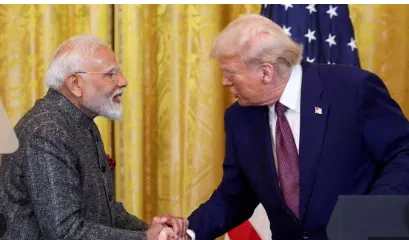
New Delhi, March 24: US President Donald Trump held a conversation with Prime Minister Narendra Modi on Tuesday, focusing on the situation in the Middle East and the critical issue of keeping the Strait of Hormuz open for international trade. US Ambassador to India, Sergio Gor, confirmed the discussion, emphasizing the importance of maintaining the freedom of navigation through the waterway, which has been disrupted by the ongoing regional conflict.
The conflict in West Asia has now entered its fourth week, severely impacting global trade routes, particularly through the Strait of Hormuz, a vital artery for crude oil transportation.
Earlier, President Trump addressed the media, assuring that the Strait of Hormuz, a key global shipping route, would "open very soon" despite the ongoing tensions. He suggested that the US and Iran could jointly manage the critical passage if current negotiations with Tehran proceed smoothly. Trump further commented, “It’ll be jointly controlled. Me and the Ayatollah, whoever the Ayatollah is, whoever the next Ayatollah is,” signaling a potential cooperative approach between the two countries in safeguarding this strategic route.
The Strait of Hormuz, responsible for the passage of around 15 million barrels of crude oil per day and 5 million barrels of oil products, accounts for nearly 25% of the world’s seaborne oil trade. The ongoing conflict has elevated risks in the region, choking the global energy supply and causing significant disruption.
President Trump also shared that the US is currently in high-level discussions with a senior Iranian official to bring an end to the conflict. However, he clarified that these talks do not involve Iran's new Supreme Leader, Mojtaba Khamenei.
In Parliament, PM Modi reassured the nation that India has been in consistent contact with Gulf countries, the US, and other key stakeholders. He stressed that India has consistently advocated for a peaceful resolution through dialogue. “Since the onset of the conflict, I have had multiple conversations with the leaders of West Asian nations. We are in regular communication with the Gulf countries, Iran, Israel, and the United States,” PM Modi said.
India’s diplomatic efforts are focused on ensuring the safe passage of its ships through the region, even amidst the ongoing crisis. "India is committed to resolving this situation through dialogue," the Prime Minister added.
PM Modi also highlighted the importance of ensuring the safety of the large Indian diaspora in the Gulf, numbering around 10 million. “Ensuring the safety of their lives and livelihoods is a key priority for India. Many ships, including those with Indian crew members, are stranded in the Strait of Hormuz. This poses a significant concern for us," Modi explained. He further emphasized that a united voice for peace and dialogue must be raised globally, especially from India’s Parliament.
In a related briefing, Rajesh Sinha, Special Secretary at the Ministry of Shipping, clarified that no special permission is needed to pass through the Strait of Hormuz. "As per international law, the Strait is an international waterway, and there is no requirement for special permission to navigate through it," Sinha stated, dismissing any claims to the contrary. He assured that while safety assessments are necessary, the legal freedom of navigation remains intact.
As the West Asian conflict shows signs of potential de-escalation, with the US initiating talks, the hope for a peaceful resolution grows. ( With Agency Input)