
.webp)
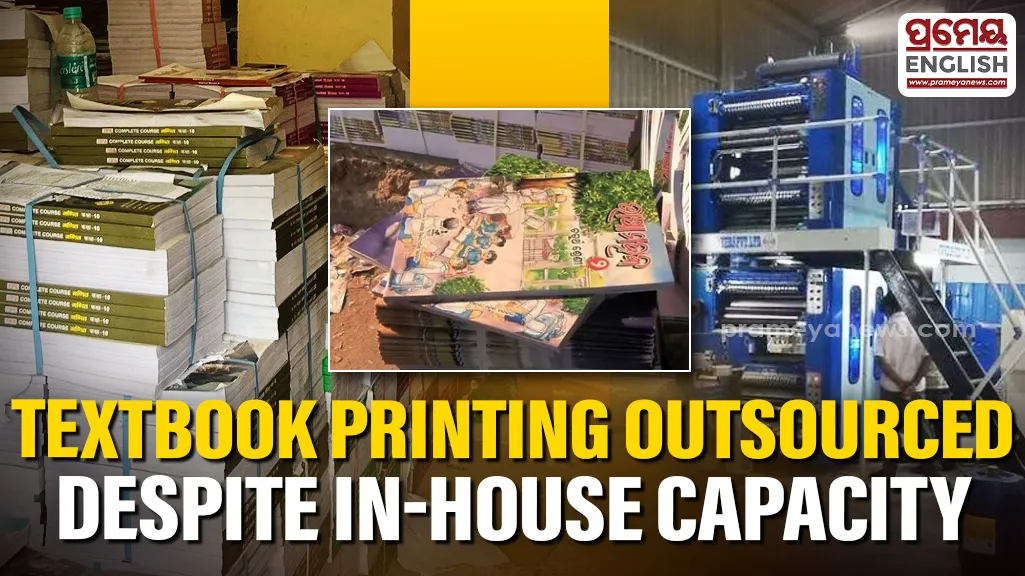
Bhubaneswar, June 23: Despite having its own printing infrastructure, the Directorate of Textbook Production and Marketing (TBPM) reportedly outsourced a significant portion of textbook printing work to private printing agencies, spending nearly ₹21 crore for the 2026–27 academic year. The move has come under scrutiny following the discovery of errors in newly printed school textbooks.
According to available information, TBPM had planned to print 29.82 million textbooks for the current academic year, an increase of approximately 2.75 million copies compared to the previous year. While government guidelines stipulate that school textbooks should be printed in government presses, officials allegedly assigned a substantial share of the work to private firms, citing increased printing requirements.
Questions have also been raised about the quality control measures followed by these private agencies. Critics claim that some printing firms may not have had adequate proofreading facilities and simply printed the content supplied by the State Council of Educational Research and Training (SCERT) without conducting thorough checks.
Printing Volume Cited as Reason for Outsourcing
In a clarification submitted to the School and Mass Education Department, TBPM stated that a state-level committee meeting held on May 21 last year decided to develop new textbooks for Classes I to VIII in accordance with the National Education Policy (NEP) 2020 and the Odisha Curriculum Framework 2025. SCERT was entrusted with the responsibility of developing the revised textbooks.
For the 2026–27 academic session, textbooks covering 55 subjects were scheduled for printing, totaling 29.82 million copies. TBPM argued that the scale of production exceeded its internal printing capacity.
The directorate noted that during the previous academic year, 27.08 million textbooks across 46 subjects were printed. This year, the number of books increased by nearly 2.75 million copies. In addition, the new textbooks contain more pages and feature multi-colour printing, making the production process more demanding.
According to TBPM, its existing facilities were not equipped to handle such a large volume of high-page, multi-colour textbooks within the required timeframe. Consequently, after informing the government, the directorate outsourced part of the printing work to private agencies.
Concerns Over Accountability
However, following the emergence of errors in the textbooks, critics have questioned whether the outsourcing decision compromised quality assurance. Observers argue that despite possessing government printing facilities, TBPM has relied on private presses for several years by citing capacity constraints, raising concerns over oversight, accountability, and the effective utilization of public infrastructure.
The outsourcing arrangement for the current academic year reportedly cost the state exchequer around ₹21 crore, adding to demands for a review of the textbook production and quality-control process.
.webp)