

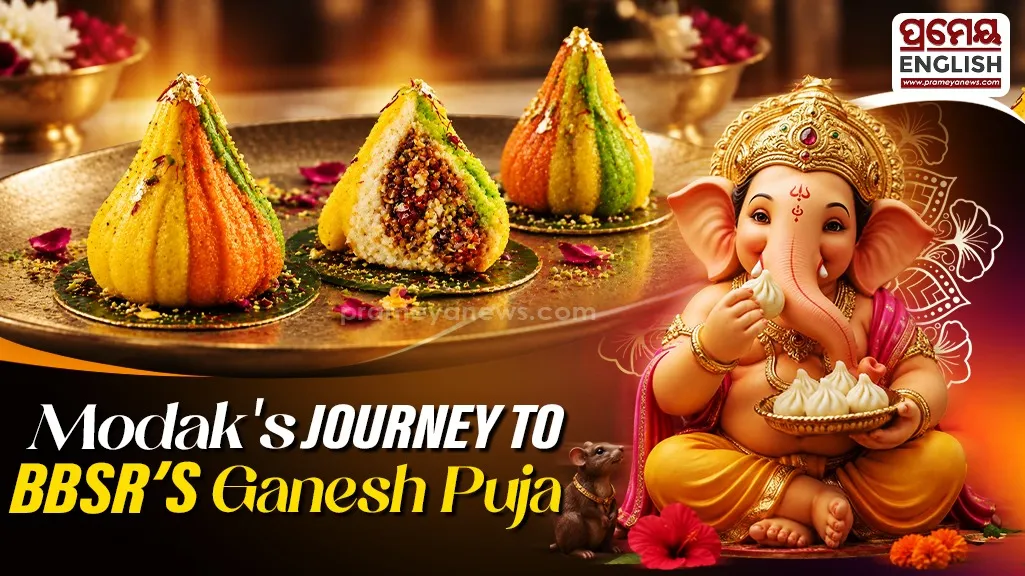
Bhubaneswar, Sept 17: The familiar sweetness of magaja laddu and seuboondi has long been part of festivities associated with Ganesh Puja in Bhubaneswar. But of late, another sweet is making its way into the festive spread: the modak.
The growing popularity of modak has emerged as a notable trend in recent years. Closely associated with Maharashtra, the steamed sweet dumpling is now appearing on the shelves of local confectionery shops and in homes across Bhubaneswar. Many people, especially younger residents, have also taken to preparing it at home, learning recipes from friends, social media and relatives in Maharashtra.
The change reflects the way Ganesh Puja in Bhubaneswar is evolving, with traditions and cuisines from different parts of the country becoming part of the city’s festive culture.As communities bring their customs with them, celebrations in Bhubaneswar are taking on new flavours without necessarily giving up the old ones.
“Social media has effectively bridged the gap between regional cultures,” said Sonali Priyadarshini, a local food enthusiast. “Since childhood, I have been curious about the taste of an authentic modak, having never visited Maharashtra. For the past two years, my hostel roommate from Nashik and I have been preparing them for Ganesh Puja, guided by her mother over video calls.”
While modaks are now prepared locally in Odisha, connoisseurs note that their flavour profile is very different from that of traditional modaks made in Marathi households across Maharashtra. The use of fragrant rice varieties such as Ambemohar or Indrayani for the dough, high-moisture Konkan coconuts, acclaimed Kolhapuri jaggery and Sajuk Toop (desi ghee) gives Maharashtrian modaks their distinctive flavour.
Gautam Singh, a Cuttack-based entrepreneur who has sampled the sweet across India, said, “I have tried modak in Bhubaneswar, Cuttack, Delhi, Mumbai and Bengaluru,” and added, “However, the ones in Mumbai were distinct. The rich aroma, flawless texture and precise flavour profile make you drool.”
As culinary boundaries expand, some residents emphasise the need to preserve regional heritage. “Access to diverse cultures and cuisines is good, but we must also safeguard our own culinary legacy,” said Vivek, a biotechnology student. “For me, Ganesh Puja is incomplete without seuboondi. I have never tried modak, but I would love to.”
Reacting to critics who view the trend as an erosion of Odia culture, Vivek added that opening up to new experiences does not mean forgetting existing practices. “Culture and traditions are dynamic, they do not exist in a vacuum. They will evolve as they always have, long after the critics are gone,” he concluded.
(Debi Prasad Sahu)