
.webp)


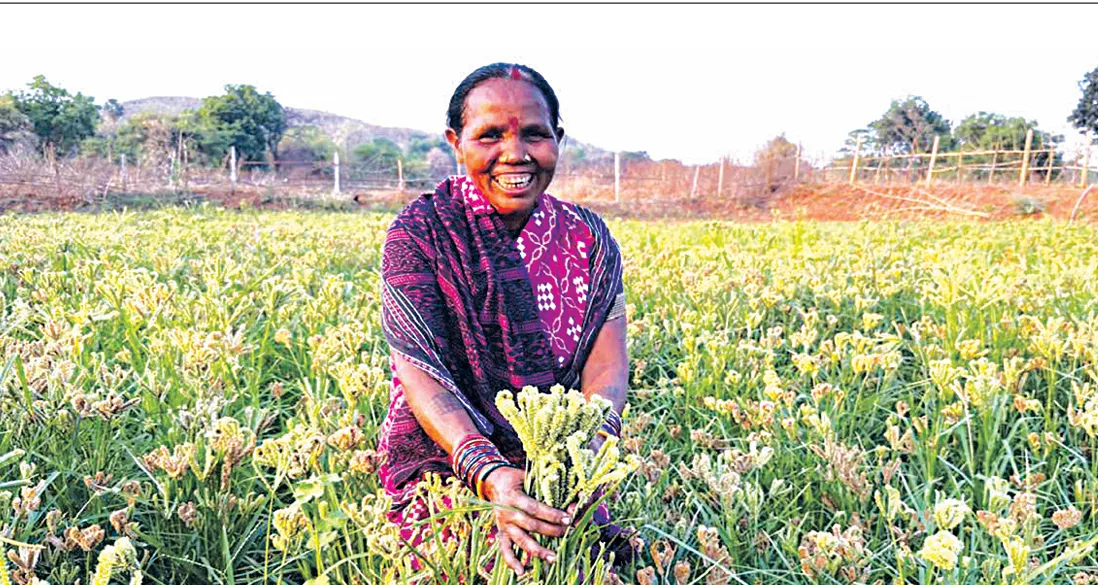
Bolangir, Nov 13: Once forced to migrate to distant brick kilns in search of a livelihood, Jashoda Bhoi has transformed her life through millet farming. Today, she is celebrated as ‘Millet Maa’ and inspires women farmers across her region.
“Will we continue to toil in brick kilns outside the state until we are reduced to dust, or will we make gold grow in our own fields?”
Faced with these two choices, Jashoda Bhoi and her husband, Dalu Barlebadia, chose the latter. What followed is a remarkable story of resilience, determination and agricultural transformation.
Hailing from Bayaudara village under Ichhapada Panchayat in Muribahal block of Bolangir district, the couple once spent their lives migrating to brick kilns in Waltair, Alakapalli and Kalipatnam in search of work. Like thousands of families from this migration-prone region, they had little choice but to leave their home every year due to a lack of employment opportunities and irrigation facilities.
Their lives took an unexpected turn in 2012 when Dalu was diagnosed with severe diabetes while working at a brick kiln. With their meagre earnings, purchasing the prescribed medicines became nearly impossible. The couple eventually returned home.
On consulting a local doctor, Dalu was advised to include locally available millets, particularly ragi (finger millet), and gurji in his diet. At one point, Jashoda had to borrow ragi from others just to feed her ailing husband.
This hardship became the beginning of a new chapter. Jashoda started cultivating a small quantity of ragi on their own land. After harvesting, she sold the surplus in the local market, gradually discovering the potential of millet farming.
Recognising her determination, the local agency ASHA and the Agriculture Department provided her with training and improved seeds under the Millet Mission in 2017. With technical guidance, she adopted better farming practices, including line sowing, mechanical weeding and the use of organic inputs such as vermicompost and Jeevamrut.
She expanded cultivation from half an acre of family land to another three acres leased from families who had migrated for work. Initially growing the traditional 'Bhudei' variety, she later successfully experimented with the improved 'Khunta' variety under the Shree Anna Abhiyan.
Today, Jashoda sells around 14-15 quintals of ragi annually, earning approximately Rs 1.5-2 lakh. Her success has also inspired other women. Under her leadership, the Shri Panchami Self-Help Group was formed, bringing together more than ten women who have taken up similar cultivation.
The transformation extends beyond the fields. Dalu's health has improved, and no one in the family needs to migrate for work anymore. Instead of struggling to make ends meet, the couple now earns a livelihood from their own agricultural efforts.
Also read: Odisha approves five instream storage projects worth ₹625 crore to strengthen rural water security
For her contribution to reviving millet cultivation, Jashoda has been recognised as a 'Millet Champion' by the Krushi Suchana O Paramarsha Kendra. At the state-level agricultural fair organised by the Department of Agriculture and Farmers' Empowerment in 2024, she was honoured with the title of 'Millet Maa'.
Today, she is regularly invited to agricultural programmes to share her experiences and train fellow farmers.
From borrowing millet to feed her husband to becoming a role model for an entire farming community, Jashoda's journey proves that with the right support, determination and access to knowledge, agriculture can offer families a dignified alternative to distress migration.
.webp)