

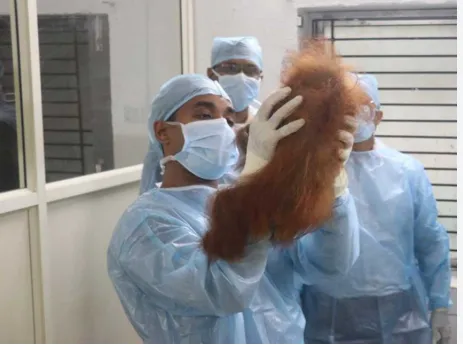
Bhubaneswar, September 16: Doctors, along with members of the Technical Committee, on Wednesday conducted a detailed health assessment of five baby orangutans rescued from an area near Badapali village in Balasore district.
As part of the medical examination, veterinarians carried out X-rays of the chest, abdomen and skull of all five animals. Blood, serum and nasopharyngeal swab samples were also collected for further laboratory analysis.
The weight assessment showed that Male 1 weighed 5.1 kg, Male 2 weighed 3.56 kg and Male 3 weighed 2.94 kg. Among the females, Female 1 weighed 4.23 kg, while Female 2 weighed 2.14 kg.
According to the initial medical observations, all five orangutan infants were maintaining regular and healthy feeding patterns during the examination. However, in-house haematology tests revealed severe anaemia in one animal and mild anaemia in two others.
Following the findings, supportive supplementation was initiated for the rescued orangutans in accordance with the directions of the Technical Committee. The animals are being kept under close observation, with veterinarians and wildlife experts monitoring their health and nutritional condition.
The five orangutans were rescued on September 9 after they were found near Badapali village under Bhograi Block in Balasore Forest Division. Their unexpected presence in the area prompted the Forest Department to begin an investigation into how the animals reached the location.
Balasore DFO Indalkar Pratik Prakash said forest officials received information from a member of the Village Forest Protection Committee (VSS) at around 6 am about five animals believed initially to be monkeys.
Forest personnel reached the spot and found that all five were very young. Although the animals were alert and active, their limited mobility raised concerns about their ability to survive independently. Officials initially provided food at the site.
As local residents began gathering around the animals, the Forest Department rescued them and shifted them to the Udaipur Section Office for proper examination and care.
The DFO said the young age and limited mobility of the animals suggested that they could not have travelled a significant distance on their own. He also pointed out that surviving overnight in the area would have been difficult because of the presence of predators and other animals, including jackals, foxes, dogs and langurs.
The Forest Department is also examining the possibility of human intervention. Orangutans are not native to India and do not naturally migrate into habitats such as the one where the five animals were found. This has raised questions about how the infants came to be in Balasore.
The rescued group comprises three males and two females, all estimated to be around one year old.
Forest officials, veterinarians and wildlife biologists have been involved in the examination and care of the animals. The Odisha Forest Department has also coordinated with scientists and experts from Nandankanan Zoological Park and the Wildlife Trust of India (WTI).
The DFO said the case requires coordination among multiple agencies because orangutans are an international wildlife species and are not native to India. Further investigation is expected to focus on determining the origin of the animals and the circumstances under which they reached Balasore.
Meanwhile, the rescued infants remain under veterinary care, with their health condition, feeding behaviour and laboratory test results being closely monitored.