



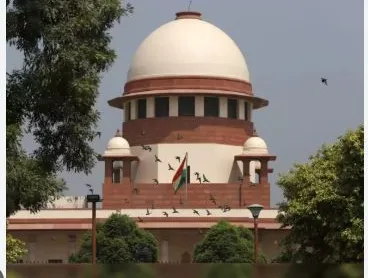
New Delhi, August 6:The Centre has opposed in the Supreme Court a petition seeking implementation of the "creamy layer" principle in reservations for Scheduled Castes (SCs) and Scheduled Tribes (STs), arguing that such a policy decision falls within the executive's domain and cannot be mandated by the judiciary.
In a counter affidavit, the Union Ministry of Social Justice and Empowerment said the petition seeks a direction to the government to frame reservation policy in a specific manner, which is beyond the scope of judicial review. It maintained that any proposal to introduce a creamy layer in SC/ST reservations would require a comprehensive empirical study and a holistic policy review.
The Centre stated that the identification of SCs, STs and Other Backward Classes (OBCs) is based on historical, social and educational backwardness rather than economic status alone. It stressed that reservations are intended to address historical discrimination, social exclusion and unequal access to education and public employment.
The affidavit argued that discrimination against SC, ST and OBC communities is rooted in social factors, not merely economic conditions. While welfare schemes for these communities often include income-based eligibility criteria, reservation in education and government jobs serves a distinct constitutional objective and is therefore treated differently.
Citing the Constitution Bench judgment in theIndra Sawhneycase, the Centre said the creamy layer principle was expressly confined to OBCs and held to have no relevance for SCs and STs. It also referred to subsequent rulings to contend that the principle has never been made applicable to Scheduled Castes and Scheduled Tribes.
The government further submitted that any move to introduce income-based exclusions within reserved categories should be preceded by detailed socio-economic research and an evidence-based policy review.
Highlighting the limited scope of judicial intervention in policy matters, the Centre said courts cannot direct the executive to frame policies in a particular manner unless they violate constitutional or statutory provisions. It argued that the petition fails to establish any infringement of fundamental rights and therefore does not warrant relief under Article 32 of the Constitution.
Describing the plea as "devoid of merit", the Centre urged the Supreme Court to dismiss it.
The petition was filed after the apex court issued notices to the Centre and all state governments on a PIL seeking implementation of the creamy layer principle in SC/ST reservations. The petitioners argued that relatively advanced families within these communities continue to receive reservation benefits across generations, limiting opportunities for the most disadvantaged sections.
The plea relies on the Supreme Court's Constitution Bench judgment inState of Punjab vs. Davinder Singh(August 1, 2024), in which a majority of judges supported sub-classification within Scheduled Castes and favoured applying the creamy layer principle. However, following the verdict, the Union government reiterated that the Constitution does not provide for a creamy layer within SC/ST reservations.