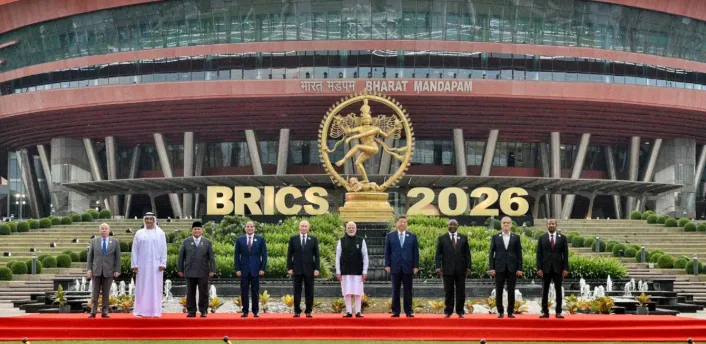
Addressing the opening session of the two-day India-hosted BRICS Summit, Modi proposed a 10-point roadmap for global governance reforms under the BRICS framework and called for the establishment of a “Seafarers’ Emergency Support Network” to protect sailors facing growing risks from global and regional conflicts.
The summit assumes significance as it brings together leaders of major emerging economies against the backdrop of the Russia-Ukraine war, escalating instability in West Asia and new US tariff policies.
Among those attending the summit are Russian President Vladimir Putin, Chinese President Xi Jinping, Iranian President Masoud Pezeshkian and Abu Dhabi Crown Prince Mohamed bin Zayed Al Nahyan.
BRICS has emerged as an influential grouping of emerging economies, with its 11 members accounting for around 49.5 per cent of the global population, 40 per cent of global GDP and 26 per cent of global trade.
As BRICS chair, India has put the Global South at the centre of its agenda, focusing on practical solutions to challenges involving food, energy and supply-chain security, particularly to shield developing economies from the fallout of geopolitical conflicts.
“The current structure of global governance resembles a pyramid: power and decision-making are concentrated at the top, while the lower tiers consist of nations that are affected by these decisions but unable to shape them,” Modi said.
“Today, the Global South stands in the front row of global crises but in the back row of decision-making. We must transform this ‘pyramid of privilege’ into a ‘platform of partnership’ — one where every nation has a voice, every member has a stake, and the development of humanity lies at the heart of every effort,” he said.
Modi proposed that BRICS jointly formulate a 10-point roadmap for reforming global governance, to be finalised by the next summit.
“In formulating this roadmap, we must focus on three key aspects: representation, responsiveness and rule-making,” he said.
Chinese President Xi Jinping described BRICS as the world’s most influential platform for cooperation among emerging markets and developing countries and called on the grouping to play its “due role” in promoting peace in West Asia.
Putin also stressed the need for united BRICS efforts to address major global challenges.
At the conclusion of the first day’s deliberations, Modi announced that the New Delhi BRICS Declaration had been adopted unanimously.
The consensus was seen as a significant diplomatic achievement for India, particularly amid sharp differences between the United Arab Emirates and Iran over the West Asia conflict. As BRICS operates largely on consensus, there had been apprehensions over whether the declaration would be adopted.
The declaration avoided any direct reference to US strikes on Iran or Iranian attacks on several Gulf Arab nations. It also refrained from directly criticising Russia over the Ukraine conflict.
However, it strongly criticised Israel over the continuing violence in Gaza and called for fulfilling the aspirations of the Palestinian people.
Without naming the United States, BRICS expressed serious concern over the growing use of “trade-restrictive actions”, including “indiscriminate” tariffs and non-tariff measures. It warned that protectionist policies could further undermine global trade, disrupt supply chains and deepen existing economic disparities.
The grouping also opposed “unilateral sanctions” and “coercive measures” that are contrary to international law, in a position viewed as a veiled criticism of Western sanctions imposed on Russia.
The BRICS leaders broadly endorsed India’s position that the West Asia conflict should be resolved through “dialogue and diplomacy”. They also stressed the need for coordinated efforts to ensure the smooth flow of global trade, supply chains and energy in accordance with applicable international law.
The grouping strongly supported India’s call for zero tolerance towards terrorism and opposed double standards in combating the menace.
The leaders condemned in the “strongest terms” the Pahalgam terror attack in Jammu and Kashmir last year, in which 26 people were killed.
In his address, Modi also highlighted the vital role of seafarers in sustaining global trade and called for greater international cooperation to protect them during crises.
“Seafarers make a massive contribution to global trade, yet they often find themselves lacking support during difficult times. I propose that we establish a ‘Seafarers’ Emergency Support Network’,” he said.
According to Modi, the proposed network would link maritime authorities and diplomatic missions of relevant countries to facilitate distress alerts, medical assistance, family notifications and evacuations.
India has repeatedly raised concerns over the safety of its seafarers amid the West Asia conflict, particularly following attacks on merchant vessels near the Strait of Hormuz. Ten Indian seafarers are among the 16 Indians killed so far in the conflict.
The BRICS declaration also called for reforms to the United Nations and supported the idea of having a woman serve as UN Secretary-General.
The first day of the summit concluded with Modi hosting a dinner reception for the participating leaders.
On the sidelines of the summit, Modi held a series of bilateral meetings, including discussions with Chinese President Xi Jinping, Malaysian Prime Minister Anwar Ibrahim and Abu Dhabi Crown Prince Mohamed bin Zayed Al Nahyan.
During his meeting with Xi, Modi stressed that peace and tranquillity along the Line of Actual Control remain essential for the continued development of India-China relations.
The two leaders reaffirmed the importance of taking a strategic and long-term view of bilateral ties and agreed that differences should not be allowed to escalate into disputes.