

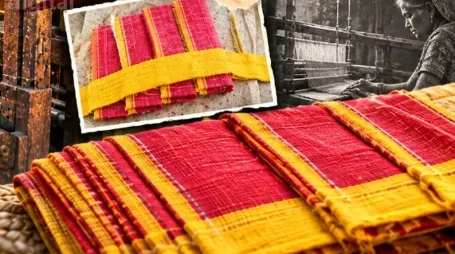
Puri, Sept 14: The rhythmic sound of handlooms is slowly fading in Alangdia village, once renowned for its distinctive ‘Machhi Gamucha’. With younger generations losing interest in weaving due to low earnings and lack of support, the centuries-old weaving tradition is now facing the threat of extinction.
Located around 4 km from Chandanpur in Puri district, Alangdia has around 70–80 weaver families who have traditionally practised handloom weaving for generations. According to local folklore, the settlement was established for members of the weaving community under the orders of Gajapati Maharaja Kapilendra Deva.
Over the years, Alangdia emerged as an important centre of handloom weaving and also remained associated with various textile services for the Jagannath Temple in Puri.
However, the traditional craft is now struggling to survive. While a handful of weavers continue the practice, many younger members of the community have moved away from the profession in search of better-paying work.
Weaver Prabhasini Maharana said the younger generation was no longer interested in weaving because the income was too low.
“Two people working for around five to six hours a day can produce only three to four gamuchas. Each gamucha is sold for around ₹100 to ₹120. Even when two members of a family work throughout the day, the income is only around ₹300,” she said.
According to her, such earnings are not enough to support a family in the present economic situation. As a result, many young people are leaving the traditional occupation, while women and elderly members of the community are keeping the craft alive.
She also called for financial assistance, better training and greater government support to promote the traditional weaving practice.
Senior weaver Rabindra Maharana stressed the need to take the Alangdia gamucha beyond local markets and create a distinct identity for the product.
He suggested promoting the gamucha in state and national markets, introducing online sales, developing a dedicated brand for Alangdia gamucha, improving product quality and packaging, and establishing sales outlets at fairs, exhibitions and tourist destinations.
He also suggested including Alangdia in rural tourism programmes.
The heritage village of Raghurajpur is located nearby and attracts tourists from across India and abroad. If Alangdia is linked with the rural tourism circuit, tourists could be encouraged to visit the village and witness the traditional weaving process while purchasing locally made products, he said.
Santosh Kumar Maharana, Assistant Secretary of the Puri Sadar Tantubaya Cooperative Society, also highlighted the need for extensive promotion of Alangdia’s traditional gamucha.
He said greater publicity could help consumers understand the unique qualities of the product, increase demand and eventually raise its price. Better prices, in turn, could ensure more reasonable remuneration for the weavers.
With the traditional craft already surviving through only a limited number of artisans, residents fear that without immediate intervention, Alangdia’s famous Machhi Gamucha and its centuries-old handloom tradition could disappear completely within the next few years.