



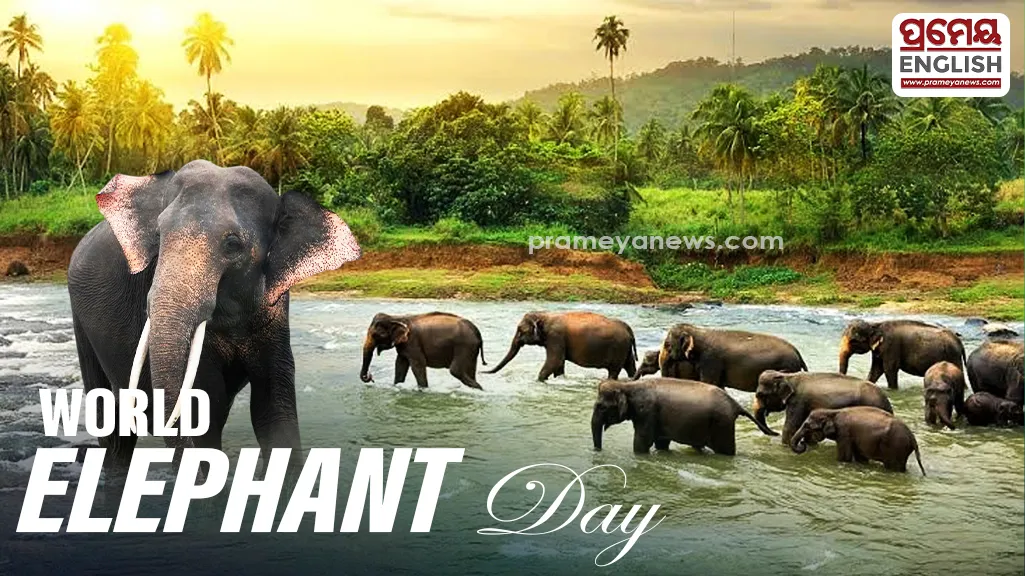
Bhubaneswar, August 12: For centuries, elephants have shared an extraordinary relationship with humans. Revered in Indian culture, worshipped as Lord Ganesha and celebrated in literature, religion and history, the elephant has always held a special place in our lives. Yet today, this majestic animal is struggling for survival.
In Odisha, the story is particularly significant. According to the 2024 elephant census, the state has 2,098 elephants. The Angul Circle has the highest population with 779 elephants, followed by other major elephant habitats such as Rourkela, Brahmapur, Sambalpur and Bhubaneswar. But numbers alone cannot tell the whole story. Behind them lies a growing battle for habitat, food and survival.
A tradition that disappeared
Elephants were once an integral part of the Puri Rath Yatra. The Gajapati Maharaja traditionally travelled on an elephant to perform Chhera Pahara. Later, elephants walked ahead of the king’s ceremonial procession.
To preserve the tradition, a domesticated elephant from Nandankanan was taken to Puri every year. But during the 1997–98 Rath Yatra, an elephant attacked its mahout near Press Square in Bhubaneswar while being transported. The animal was eventually brought under control, but the incident marked the end of the practice. Since then, elephants from Nandankanan have not been taken to Puri for the Rath Yatra.
A dangerous road to survival
Elephant deaths in Odisha have increased significantly over the decades. The average annual mortality rose from about 33 elephants between 1990 and 2000 to 46 between 2000 and 2010, and around 75 between 2010 and 2020.
The causes are many—poaching, electrocution, railway and road accidents, and even deliberate poisoning of fruits and plants. As forests shrink, elephants increasingly enter human settlements in search of food, creating a dangerous conflict for both sides.
An adult elephant may spend 17–18 hours a day feeding and depends on dozens of plant species. When forests cannot provide enough food, villages and agricultural fields become the next destination.
Mining, industries, roads, railways and other human activities have fragmented elephant habitats and disrupted their traditional routes. Though Odisha identified 14 elephant corridors in 2010, many of these pathways remain under pressure.
The matriarch leads the way
Elephants are deeply social animals. Herds are usually led by an experienced adult female, while younger elephants stay protected in the middle during river crossings and journeys. Young males eventually leave the herd and may become solitary tuskers.
A female elephant usually becomes reproductively mature at around 12 years and has a gestation period of nearly 22 months. With such a slow reproductive cycle, every elephant lost is a serious blow to the population.
A call to protect the giants
From Haathi Mere Saathi to Junglee and other Indian films, elephants have often found a place on the silver screen. But their real story is unfolding in Odisha’s forests.
Conservation cannot remain limited to census figures or awareness days. Protecting forests, restoring elephant corridors, reducing human-wildlife conflict and making communities partners in conservation are essential.
The elephant has walked alongside human civilization for centuries. The question now is whether we will make enough space for it to continue that journey.